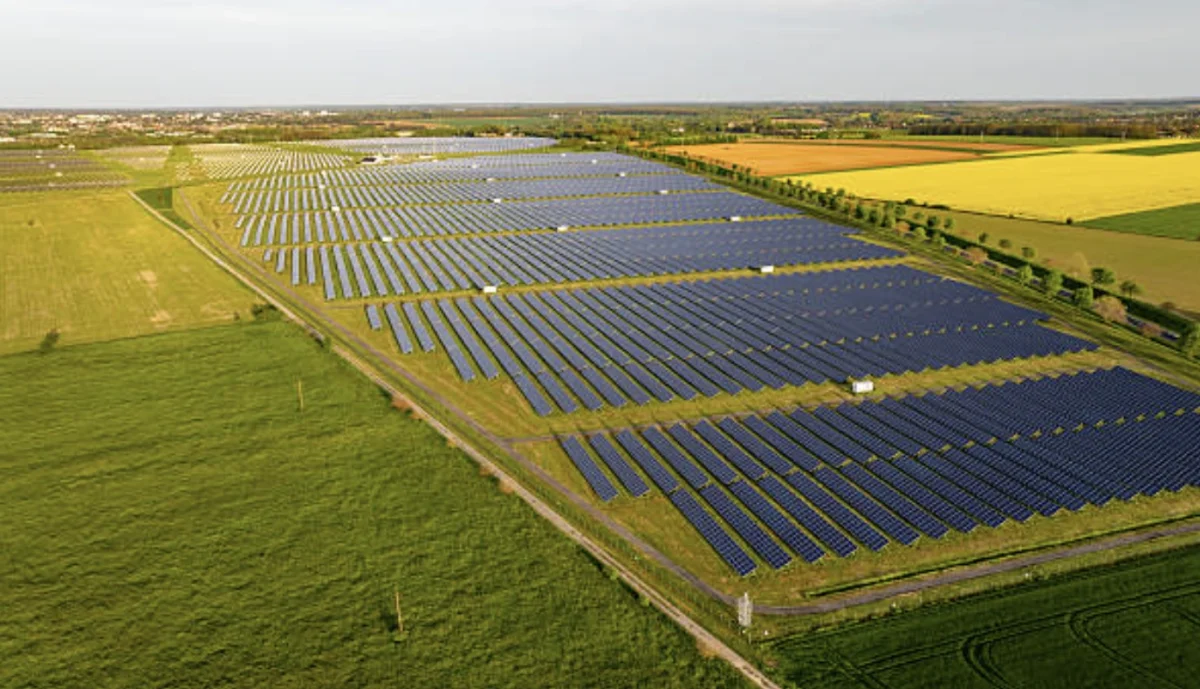
Germany is in the middle of a ground-mounted solar boom — but a quirk in its inheritance tax code is threatening to slow it down before it reaches its potential. The country’s leading energy trade body has raised the alarm, and the stakes extend far beyond individual farmers’ tax bills.
- The solar boom hiding a tax trap
- How Germany’s inheritance tax works for farmland
- Why leasing land for solar changes everything
- The real-world impact on farmers and developers
- What the BDEW is proposing
- The bigger picture: Germany’s 2030 solar targets
The solar boom hiding a tax trap
Germany’s renewable energy transition is accelerating — but unevenly. While rooftop solar installations have been stalling, ground-mounted solar parks have surged. In the first three months of 2026, ground-mounted solar was the only PV sector in Germany to experience year-on-year growth, accounting for nearly half of the 3.51GW added in Q1.
Yet just as this sector reaches a critical moment, the German Association of Energy and Water Industries (BDEW) has issued a stark warning: an overlooked feature of Germany’s inheritance tax system is creating a significant disincentive for the farmers whose land is essential to the solar rollout.
Q1 2026 PV added: 3.51 GW
Ground-mounted share of Q1: ~50%
Germany 2026 capacity target: 128 GW
AgriPV potential (Fraunhofer): 500+ GW

How Germany’s inheritance tax works for farmland
Under German law, agricultural and forestry assets — including farmland — have historically benefited from generous inheritance and gift tax reliefs. These exemptions, set out under Sections 13a and 13b of the German Inheritance Tax Act (Erbschaftsteuergesetz, or ErbStG), are designed to ensure that family farms can be passed between generations without triggering a tax bill that forces a sale of the land.
For decades, this framework has worked reasonably well for traditional farming. The problem arises when that farmland is used for something other than agriculture — specifically, when it is leased to a solar energy developer for a ground-mounted PV installation.
Under current rules, agricultural land leased for a ground-mounted solar project is no longer classified as an agricultural or forestry asset for tax purposes. This single reclassification can have severe financial consequences for farming families.
Why leasing land for solar changes everything
Kerstin Andreae, chair of the BDEW executive board, has explained that if agricultural land is leased for PV systems, it would no longer be considered agricultural or forestry assets for tax purposes. The moment a farmer signs a solar lease, the land loses its tax-privileged status — and with it, the inheritance protections that have long underpinned multi-generational farm ownership in Germany.
The consequences can be severe. In some cases, the resulting tax liability may even exceed the total lease income generated over the entire lifetime of a solar park — meaning a farmer could, in theory, earn less from the solar lease than they end up paying in inheritance tax as a direct result of having signed it.
Agricultural land (standard)
- Classified as agricultural asset
- Qualifies for ErbStG tax relief
- Inheritance tax reduced or waived
- Farm can pass between generations
Land leased for solar
- Reclassified as non-agricultural
- Loses ErbStG exemption status
- Full inheritance tax may apply
- Tax can exceed total lease income
The real-world impact on farmers and developers
The practical consequences of this tax treatment ripple outwards from individual farm families to the entire ground-mounted solar sector. Farmers who might otherwise welcome a solar lease — which can generate between €1,000 and €3,500 per hectare per year, several times the typical farmland rental rate — are understandably reluctant when they understand the inheritance tax exposure it creates for their heirs.
This creates what the BDEW describes as a damaging cycle of uncertainty: farmers hesitate to sign leases, developers struggle to secure sites, legal agreements become more complex and expensive to negotiate, and the rollout of ground-mounted PV slows as a result — directly undermining Germany’s national clean energy targets.
“The expansion of ground-mounted photovoltaic systems… is being slowed by the current inheritance tax treatment of agricultural land leased for solar use.”— BDEW position paper, June 2026
What the BDEW is proposing
The BDEW has put forward two concrete solutions to resolve the tax classification problem, which it outlined in a formal position paper submitted to German policymakers.
Proposal 1 — Preferred solution
Retain agricultural classification during PV use
Land used temporarily for a solar installation should continue to be classified as an agricultural asset for the duration of the PV lease. The BDEW describes this as “the most straightforward and practical solution” — preserving the inheritance tax exemption while allowing the land to generate clean energy income.
Proposal 2 — Alternative measure
A dedicated tax relief provision for ground-mounted solar
If full reclassification is not adopted, the BDEW proposes introducing a specific tax relief mechanism for ground-mounted solar projects — for example, through a flat-rate valuation discount or a tax-free allowance targeted at agricultural land in PV use.
It is worth noting that agri-PV installations — where solar panels are combined with continued agricultural activity on the same land — do retain their agricultural classification under existing state decrees, since farming activity is maintained. The tax problem specifically affects standard ground-mounted solar where agricultural use has been suspended.
The bigger picture: Germany’s 2030 solar targets
The stakes here extend well beyond individual farm finances. To comply with its applicable expansion trajectory, Germany would need to reach 128 GW of cumulative PV capacity by the end of 2026 alone. The government’s longer-term ambition is to reach 400 GW by 2045 as part of its path to carbon neutrality.
Research from the Fraunhofer Institute for Solar Energy Systems suggests Germany could install more than 500 GW of agrivoltaics capacity on its most suitable land — more than double the total installed capacity targeted by 2030. Realising even a fraction of that potential depends on farmers being willing partners in the energy transition rather than reluctant bystanders deterred by tax risk.
The BDEW’s intervention is therefore not simply a technical tax complaint. It is a policy alert about a structural barrier that, if left unresolved, could slow one of the most important drivers of Germany’s clean energy future at exactly the moment when momentum is building.
Germany remains one of the leading European markets for new solar PV installations. It added 16.2 GW of new capacity last year, and ground-mounted solar is now the sector’s primary growth engine — making the resolution of this inheritance tax barrier a matter of national energy policy, not just rural taxation.
Sources: BDEW position paper (June 2026), PV Tech, Fraunhofer ISE, Renewables Now, Clean Energy Wire. This article is for informational purposes only and does not constitute tax or legal advice.