From Google to the Smoker
Salahin Abdul Caffy spent 14 years in Silicon Valley, working at companies including Google, YouTube, Shopify, and Microsoft, before walking away from tech entirely. He didn’t leave with a business plan. He left disillusioned, looking for a fresh start, and taught himself to smoke brisket from YouTube videos, selling it out of his own house.
Today, he owns Cafe Barbecue in Irving, Texas — a halal barbecue restaurant that generated just under $2.3 million in revenue in its first year and is projecting $3.6 to $4 million in its second. It’s also, by his own account, the only restaurant of its kind serving halal Wagyu barbecue in the state, and quite possibly the country.
The specific story is unusual. But underneath it is a genuinely transferable set of business lessons about niche strategy, cost management, and turning constraints into competitive advantages — useful well beyond barbecue.
Lesson 1: The Best Niches Are Often Built by Subtraction, Not Addition
Caffy didn’t invent a new cuisine or chase an emerging food trend. He entered one of the most competitive, saturated restaurant categories in America — Texas barbecue — and won a specific segment of it by removing something almost every competitor relies on: pork.
That choice sounds like a disadvantage on its face. Pork, as Caffy explains it, is typically the highest-margin item on a Texas barbecue menu, since it’s inexpensive to source and fast to cook. By committing to a fully halal menu, he cut himself off from the easiest profit center in the entire category. But that same restriction is exactly what created his market position: an entire segment of halal-observant customers in Texas had never been able to walk into a barbecue restaurant and eat everything on the menu. By his own estimate, roughly half of his customers keep halal and half don’t — meaning the restriction didn’t just serve an underserved niche, it created a genuinely new, broader customer base that didn’t previously have a reason to choose barbecue at all.
The transferable lesson: a real, defensible niche often comes from what you’re willing to give up, not what you’re willing to add. Competitors who won’t accept the same constraint usually can’t easily copy the position it creates.
Lesson 2: Validate the Idea Cheaply Before You Spend Big
Before signing a lease or ordering equipment, Caffy tested demand the low-risk way: running brisket drops out of his own home as a self-funded pop-up. Over one year of doing this on the side, he generated around $60,000 in revenue — not enough to live on, but more than enough to prove real demand existed before committing serious capital.
Only after that validation did he move toward opening an actual restaurant, a decision that eventually required roughly $500,000 in startup costs: about $100,000 in furniture, $200,000 in equipment, and $200,000 in construction, even before the doors opened.
The transferable lesson: the pop-up, side-hustle, or minimum-viable version of a business idea isn’t just a smaller version of the real thing — it’s a cheap way to find out whether the real thing is worth building at all.
Lesson 3: Constraints Force Innovation That Becomes Your Moat
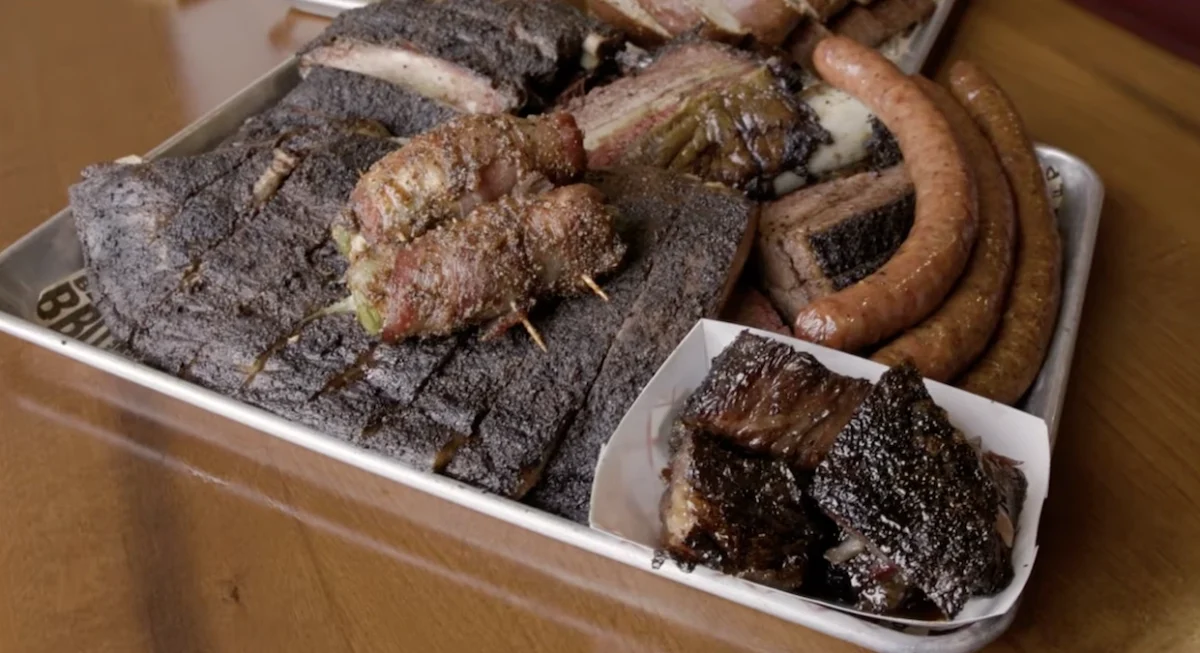
Committing to halal barbecue didn’t just mean removing pork from the menu — it meant re-engineering processes that the entire barbecue industry has standardized around pork for decades. Standard sausage-making relies heavily on pork fat as a binding agent and pork casings for the sausage itself; Caffy couldn’t use either. Making a fully halal, 100% Wagyu beef sausage required extensive experimentation to get the right binding consistency, and sourcing suitable alternatives, like more delicate lamb casings imported from New Zealand, introduced its own production challenges.
The same pattern repeated with the restaurant’s halal take on a Texas Twinkie (a jalapeño stuffed with cream cheese and brisket, traditionally wrapped in pork bacon and glazed). Caffy’s version required making beef bacon entirely from scratch from Wagyu beef belly, since beef bacon behaves completely differently than pork bacon in cooking, meaning none of the standard techniques or timing applied.
The transferable lesson: the specific technical problems a constraint forces you to solve often become the hardest part for competitors to replicate later. A restriction that seems purely limiting can end up manufacturing your competitive moat.
Lesson 4: Not Every Menu Item Needs to Be Profitable on Its Own
Caffy is explicit that his brisket, the centerpiece of the menu, operates on extremely thin margins, and that the business only works because a strong sausage program effectively subsidizes it. At the far end of that same logic sits the restaurant’s Wagyu “dino rib” — priced high, marketed almost as a showpiece, and described by Caffy as having the lowest margin of anything on the menu. It isn’t there to make money directly. It’s there because it reliably sells out first and pulls in customers excited specifically to try it.
The transferable lesson: a menu, or more broadly a product lineup, functions as a portfolio, not a set of independently priced items. Some items exist to drive traffic and attention; others need to carry the actual margin. Trying to make every single item individually profitable can mean missing the bigger strategic picture of how they work together.
Lesson 5: High Revenue Doesn’t Mean High Margin — Know Your Full Cost Stack
A restaurant pulling in $2.3 million in its first year sounds like an unambiguous success story, and in many ways it is. But Caffy is candid about just how much of that revenue gets absorbed by operating costs. Monthly expenses run roughly $120,000 to $130,000 in food costs alone, plus about $50,000 in labor, with rent, utilities, marketing, disposables, spices, and firewood adding several thousand dollars more on top. In total, the restaurant spends somewhere around $210,000 to $220,000 a month to operate — meaning even at a strong revenue run rate, the actual profit left over is comparatively modest.
The transferable lesson: revenue is a vanity metric until it’s measured against the full cost stack behind it. A business can look highly successful on top-line numbers alone while still operating on a genuinely thin margin underneath.
Lesson 6: Automate the Bottleneck Once the Math Justifies It
When Cafe Barbecue first opened, all of its sausage was made entirely by hand, a process that consumed roughly 50 labor-hours a week across four employees. Caffy eventually invested $45,000 in a specialized German-made sausage linker, a machine that let a single employee produce around 1,000 sausages an hour, while also solving a consistency problem, ensuring every sausage came out the exact same weight, something that’s essentially impossible to achieve reliably by hand.
The transferable lesson: automation decisions are clearest when they solve two problems at once, cost and quality consistency, not just one. A labor-saving investment that also improves product uniformity is a considerably easier case to justify than either benefit alone.
Lesson 7: Premium Pricing Needs a Visible, Specific Justification
Cafe Barbecue’s brisket sells for around $45 a pound, compared to a local market average closer to $38 to $39. Caffy doesn’t treat that gap as an arbitrary premium; he ties it directly to specific, communicable reasons: locally sourced ingredients, halal Wagyu beef that’s genuinely difficult to source at scale, and a strict from-scratch policy across the entire menu, down to shredding their own cheese in-house specifically to avoid the cellulose fillers used in pre-shredded cheese.
The transferable lesson: customers tolerate premium pricing far more readily when the reasons behind it are specific and visible, rather than simply assumed. “We charge more because it’s better” is a weak pitch; “we charge more because of these three specific, verifiable things” is a considerably stronger one.
Lesson 8: Founder Sacrifice in Year One Is Often Invisible From the Outside
Despite generating nearly $2.3 million in revenue in year one, Caffy says he hasn’t paid himself anything since the restaurant opened, funding his own living expenses out of personal savings instead. From the outside, a business generating that kind of revenue can look like an unambiguous success story. From the inside, the founder was still operating at personal financial risk well after the business itself was generating serious revenue.
The transferable lesson: a business’s top-line success and its founder’s personal financial security are two separate timelines, and they often don’t move together, particularly in capital-intensive, high-overhead industries like restaurants.
The Numbers Behind the Story
- $60,000 — revenue from the original home-based pop-up phase, before opening a physical restaurant
- ~$500,000 — total startup cost to open Cafe Barbecue (furniture, equipment, construction)
- ~$400,000 — additional equipment spending since opening
- $2.3 million — total revenue in year one (2026)
- $3.6–4 million — projected revenue for year two
- ~$210,000–220,000 — estimated total monthly operating costs
- $45,000 — cost of the specialized sausage-linking machine that replaced roughly 50 labor-hours a week
- 13 — number of spices in Caffy’s proprietary barbecue rub, compared to roughly 4–5 at a typical barbecue restaurant
What This Means for Other Founders
This case is a useful reminder that a genuinely differentiated business often comes from taking a real constraint seriously rather than avoiding it, and then being transparent enough about the resulting cost and complexity that customers understand exactly what they’re paying for. It also illustrates a pattern worth remembering in any high-overhead, low-margin industry: strong top-line revenue and strong actual profitability are not the same story, and founders evaluating a similar venture should model the full cost stack, not just the achievable revenue, before assuming a high-revenue year automatically translates into a financially secure one.
Where This Case Study Has Limits
A few caveats are worth noting for anyone treating this as a fully generalizable model. First, this account is drawn from the founder’s own description of his business, without independently verified financial statements, so exact revenue and cost figures should be treated as self-reported rather than audited. Second, halal barbecue in Texas represents a genuinely specific market opportunity tied to regional demographics and an underserved niche; the same specific strategy (removing pork, sourcing premium halal Wagyu) wouldn’t necessarily translate to other regions or categories without a comparably underserved audience already in place. Third, the business is still relatively young, having opened in December 2024, so its long-term profitability and ability to sustain projected growth aren’t yet demonstrated over a longer track record.
Frequently Asked Questions
What makes halal barbecue harder to produce than standard barbecue?
Standard barbecue and sausage-making techniques often rely on pork, whether as the primary meat, a fat source for binding sausage, or casings, none of which halal preparation allows. This forces halal barbecue makers to re-engineer standard techniques using beef and lamb alternatives instead.
How much does it cost to open a barbecue restaurant like this?
In this case, initial startup costs were approximately $500,000, covering furniture, equipment, and construction, with several hundred thousand dollars more spent on additional equipment after opening.
Is a high-revenue restaurant automatically a profitable one?
Not necessarily. In this case, despite $2.3 million in first-year revenue, monthly operating costs of roughly $210,000–220,000 meant the actual profit margin remaining was comparatively thin, and the founder had not yet taken a personal salary from the business.