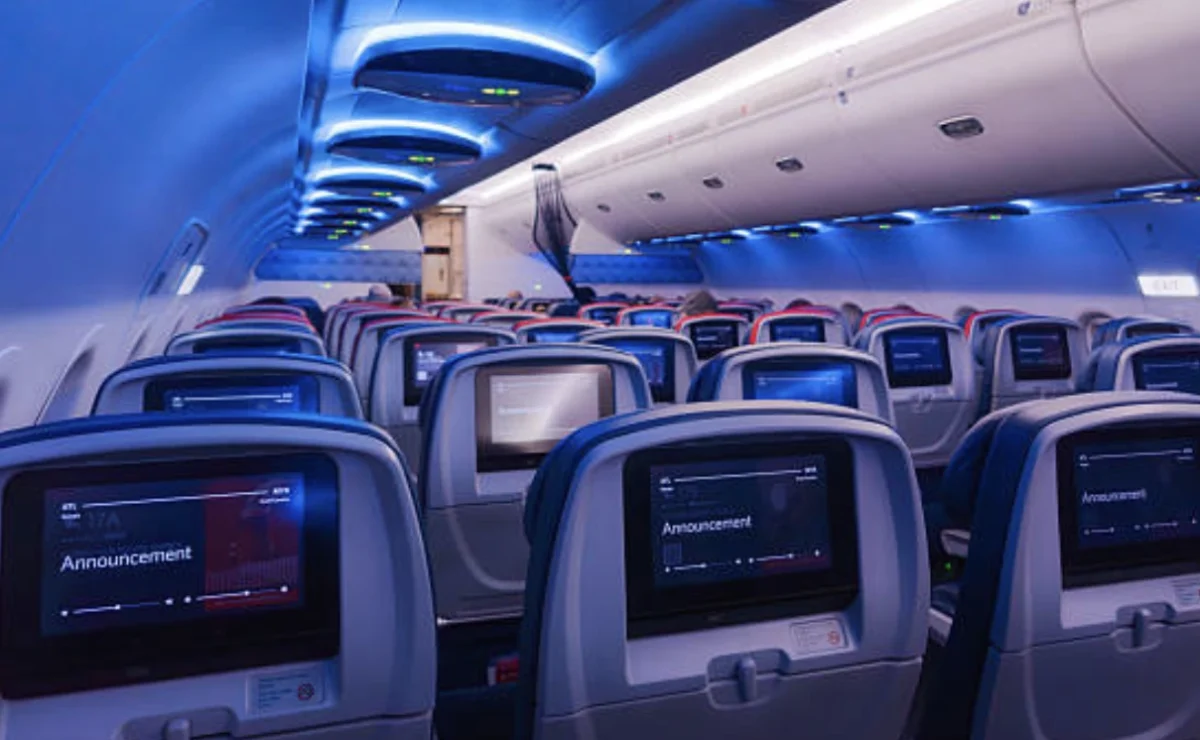
When passengers board a modern airliner today, they expect more than just a seat and a safe flight. They expect streaming-quality internet, personalized entertainment, seamless digital services, and a connected experience that feels no different from being on the ground.
That expectation has sparked one of the most important technology battles in aviation — and at the center of it is a surprising decision by Delta Air Lines to reject SpaceX’s rapidly expanding Starlink service in favor of the much newer Amazon Leo satellite network.
At first glance, the move seems counterintuitive.
Starlink already dominates the low-Earth orbit satellite internet market with more than 10,000 satellites in orbit and millions of users worldwide. Amazon Leo — formerly known as Project Kuiper — has only deployed a few hundred satellites so far and has not fully launched commercial service globally.
So why would Delta choose the underdog?
The answer reveals something much bigger than airplane WiFi.
This is not simply a technology competition. It is a fight over who controls the future digital ecosystem of air travel.
The Real Battle Is About Customer Ownership
Publicly, the debate intensified after Elon Musk criticized Delta’s decision on X.
Musk argued that Starlink offers a frictionless internet experience without requiring passengers to go through airline portals or login systems.
“Starlink WiFi must just work effortlessly every time, as though you were at home,” Musk posted.
He further claimed Delta’s approach would make internet access “painful, difficult and expensive” for passengers.
But Delta pushed back strongly, saying the airline chose Amazon Leo for broader strategic reasons beyond connectivity alone.
That response may reveal the real issue.
Airlines increasingly see onboard internet not merely as a utility, but as a strategic digital platform.
The WiFi portal is no longer just a login page. It has become:
- a loyalty engine,
- a customer data gateway,
- an advertising platform,
- a streaming hub,
- an e-commerce channel,
- and potentially a future AI-powered travel assistant.
In other words, airlines no longer want to simply provide internet access. They want to own the passenger relationship during every moment of the journey.
Why Amazon Leo Fits Delta’s Bigger Vision
Amazon brings something to the table that Starlink currently does not: a massive integrated ecosystem.
Through Amazon Leo, Delta may eventually gain access to synergies involving:
- Amazon Web Services cloud infrastructure,
- AI-driven personalization,
- entertainment integration,
- retail commerce,
- smart mobility,
- and advanced data analytics.
For enterprise customers and airlines alike, Amazon’s ability to connect satellite broadband directly into AWS private cloud systems creates an especially attractive proposition.
This transforms connectivity from a standalone service into part of a broader digital infrastructure strategy.
Delta itself hinted at this when it said Amazon shared its vision for the “next era of connected travel.”
That phrase is critical.
The airline is not simply buying internet service. It is investing in a long-term digital ecosystem.
Starlink’s Strength Could Also Be Its Weakness
There is little doubt that Starlink currently leads the market technologically.
Its vast constellation allows high-speed, low-latency internet across remote regions, oceans, and polar routes. Several major airlines around the world have already adopted the service.
But Starlink’s philosophy of simplicity — internet access without friction — may create tension with airlines that want deeper customer engagement.
Airlines increasingly depend on:
- loyalty programs,
- customer analytics,
- personalization,
- and ancillary digital revenue.
If passengers connect directly to Starlink with minimal airline interaction, carriers risk losing visibility into customer behavior and engagement patterns.
From Delta’s perspective, that may weaken its long-term competitive position.
The situation mirrors broader digital platform battles across industries:
- Apple versus telecom operators,
- Netflix versus cable companies,
- Amazon Marketplace versus traditional retailers.
The central question remains the same:
Who owns the customer interface?
Amazon’s Long-Term Strategy Should Worry Competitors
What makes Amazon Leo especially dangerous to competitors is that Amazon rarely enters markets with narrow objectives.
Historically, Amazon builds infrastructure first — then expands outward into adjacent industries.
That pattern transformed:
- AWS into a cloud computing powerhouse,
- Prime into a media ecosystem,
- and Amazon logistics into a global delivery network.
Leo could follow the same trajectory.
Satellite broadband may become:
- the infrastructure layer,
- while commerce, cloud services, mobility, entertainment, AI, and connected devices become the monetization layers built on top.
This is precisely why the aviation industry is paying close attention.
Amazon is not approaching satellite internet as a telecom business alone.
It is positioning connectivity as part of a much larger ecosystem strategy.
The Future “Digital Cabin”
The modern aircraft cabin is rapidly evolving into a digital platform.
Future airline connectivity systems could support:
- personalized entertainment,
- onboard shopping,
- targeted advertising,
- real-time travel services,
- gaming,
- productivity tools,
- connected vehicles,
- AI assistants,
- and seamless loyalty integration.
In this environment, internet connectivity becomes strategically comparable to smartphone operating systems or app ecosystems.
Whoever controls that layer may control the economics of future travel experiences.
That explains why airlines are making decisions based not only on speed and coverage, but also on strategic alignment and long-term ecosystem control.
A New Era of Aviation Competition
The Delta–Amazon Leo partnership signals a broader shift in aviation and technology.
Airlines are no longer simply transportation companies. They are becoming digital experience platforms.
Meanwhile, satellite internet providers are no longer just connectivity vendors. They are evolving into ecosystem players competing for control over data, customer relationships, and digital infrastructure.
The battle between Starlink and Amazon Leo may ultimately shape:
- how passengers experience travel,
- how airlines monetize digital engagement,
- and how global connectivity ecosystems evolve over the next decade.
And despite Starlink’s early lead, Amazon’s entry changes the competitive landscape dramatically.
Because when Amazon enters a market, competitors know the battle is rarely just about the original product.
It is about the ecosystem that comes next.