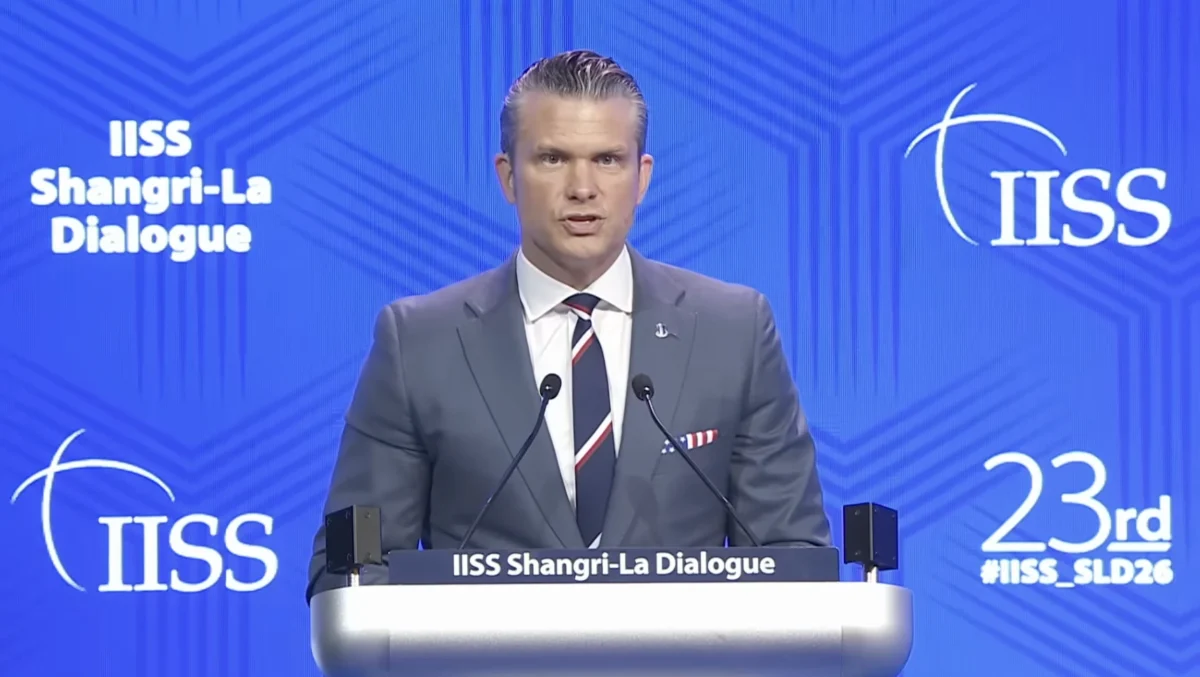
In a landmark address at the 2026 Shangri-La Dialogue, US Secretary of War Pete Hegseth delivered a blunt, unvarnished vision of the Pacific region that breaks sharply from decades of American foreign policy. Speaking under the banner of President Donald Trump’s second term, Hegseth outlined a doctrine of “flexible practical realism” – one that abandons what he called “utopian globalism” in favor of power, burden-sharing, and strategic clarity.
The core message, repeated like a mantra, was simple: strong, quiet, clear.
The End of Dependency
Hegseth opened by declaring that “the era of the United States subsidizing the defense of wealthy nations is over.” The Pacific, he argued, has long understood a truth that Western Europe has yet to learn: durable alliances are not built on idealistic values but on the concrete alignment of national interests.
“We need partners, not protectorates,” Hegseth said. Washington will no longer tolerate “freeloading.” Instead, alliances will be judged not by the number of flags at conferences, but by “the number of formations” – by combat power, not communiqués. His sharpest line drew audible tension in the room: “Less Shangri-La, more ships, more subs.”
The China Equilibrium
Perhaps most significantly, Hegseth framed US-China relations as entering a new, more stable phase. He revealed that President Trump and President Xi recently held “hours of candid conversations” in Beijing, which he personally witnessed. Both leaders agreed to build a “constructive relationship of strategic stability based on fairness and reciprocity.”
Yet this détente is not built on trust, but on deterrence. The Pentagon’s goal, Hegseth explained, is a “favorable but durable balance of power” in which no state – including China – can impose hegemony. The operational centerpiece is deterrence by denial along the First Island Chain, a strategy designed to make aggression “infeasible, escalation unattractive, and war irrational.”
America, he insisted, defends the status quo – the open commerce, respected sovereignty, and national freedom of choice that have fueled Asia’s rise.
The Burden-Sharing Scorecard
Hegseth offered explicit praise for allies stepping up, and implicit warning for those who are not.
- South Korea was lauded for raising defense spending to 3.5% of GDP and assuming greater conventional defense responsibilities.
- The Philippines earned recognition for a 12% budget increase and the largest-ever Balikatan exercises.
- Japan is accelerating its defense transformation, though “heavy lifting” remains.
- Australia is expanding rotational US forces and integrating industrial bases.
- Singapore, Indonesia, Malaysia, Thailand, and Vietnam were all cited for practical cooperation – from modernizing militaries to deploying ASEAN observer teams.
- India was named a “critical anchor” for power projection in the Indian Ocean, with co-production deals on Javelin missiles underway.
The message was unmistakable: model allies get front-of-the-line access to expedited arms sales, deep industrial collaboration, and expanded intelligence sharing. Those who continue to free-ride will face a “clear shift in how we do business.”
The Military Buildup
To back this vision, Hegseth announced that after spending $1 trillion on defense last year, President Trump is requesting a $1.5 trillion generational investment this year – far exceeding the 3.5% benchmark demanded of allies. The goal: unleash “America’s arsenal of freedom” and expand military dominance for decades.
A Rooseveltian Echo
Repeatedly, Hegseth channeled Theodore Roosevelt: “Speak softly and carry a big stick.” But the speech also carried a harder edge. The performative outrage and “empty globalist rhetoric” of the past are gone. In their place is a Department of War focused on lethal capabilities, strategic discipline, and businesslike cooperation.
“Those who long for peace must prepare for war,” he concluded, invoking his first rifle platoon’s motto. “From my first platoon to the First Island Chain.”
The Takeaway
For international relations analysts, Hegseth’s speech signals a fundamental reordering of US Pacific strategy. It is neither isolationist nor interventionist, but conditional realist: America will lead, but only if allies carry their weight. China will be engaged, but from a position of unquestionable strength. And the region’s long-standing preference for quiet, steady power – rather than rhetorical theatrics – has finally found a willing partner in Washington.
Whether the Pacific’s diverse nations embrace this “strong, quiet, clear” bargain – or resist its harder edges – will define the next era of global order.