
Eighty percent of Gen Z homeowners who bought their current home received financial help with the down payment, and a third of them say they could not have bought at all without it (LendingTree, 2026). A generation ago, that same statistic sat at 12% for baby boomers buying their first home. The American Dream hasn’t disappeared so much as it has acquired a prerequisite: a parent with equity, savings, or a willingness to co-sign.
This matters now because two trends are colliding at once. Housing and education costs have detached from what a single paycheck can support, while $84.4 trillion in baby boomer and Silent Generation wealth is scheduled to change hands by 2045 — more than half of it within the next decade (Cerulli Associates, 2026). The result is a milestone economy increasingly sorted not by effort or income, but by family balance sheets. This article’s core claim: parental financial support has shifted from an occasional boost to a structural precondition for reaching traditional adulthood milestones in the US, and that shift is quietly becoming one of the most consequential — and least discussed — drivers of wealth inequality in the country.
What follows: how housing and education costs pulled parents into the role of financial backstop, what the survey data actually shows across generations, why this both is and isn’t a new phenomenon, how the US compares with the UK’s more entrenched “Bank of Mum and Dad,” and what it means for the roughly half of young adults whose parents can’t help at all.
Background and Context
The Bank of Mom and Dad is shorthand, popularized first in the UK and now standard in US financial media, for parents and grandparents providing cash gifts, loans, co-signing, or free housing to adult children to help them afford a home, education, or other major expense. It is distinct from an inheritance, which transfers wealth after death; Bank of Mom and Dad support is typically “giving while living,” delivered specifically to clear a financial gate the recipient couldn’t clear alone.
The structural backdrop is a widening gap between cost and income. The national home-price-to-income ratio reached 5.08 in 2026, far above the 2.6 ratio economists generally consider affordable, and home prices have risen 551% since 1980 against 373% income growth over the same period (Harvard Joint Center for Housing Studies, State of the Nation’s Housing 2026). Our earlier analysis of why a middle-class salary no longer buys a middle-class home traces this gap in detail. The consequence shows up directly in buyer demographics: the median age of a first-time homebuyer hit a record 40 in 2025, up from 29 in 1981, and first-time buyers now make up just 21% of the market, down from 44% in 1981.
This isn’t only a housing story. Parent PLUS federal loans — a debt instrument that puts the legal obligation on the parent, not the student — reached $113 billion held by 3.5 million parents as of Q3 2025, about 6.7% of all federal student debt (Federal Student Aid data, cited in The College Investor, 2026). Starting July 1, 2026, new Parent PLUS borrowing is capped at $20,000 per year and $65,000 total per student, with no income-driven repayment option available — a change that intersects directly with the broader unraveling of federal repayment flexibility we covered in what to do after your student loan repayment plan got eliminated and in our explainer on income-driven student loans. Together, housing and education form the two largest gates where family money now functions as the deciding factor in whether — and when — a young adult clears them.
Core Analysis
The Data Behind the Down Payment
Claim: Parental assistance has become the norm, not the exception, for first-time homebuyers, and its role is growing sharply by generation.
Evidence: According to LendingTree’s 2026 survey of first-time buyers, 80% of Gen Z homeowners received down payment help, compared with 56% of millennials and just 12% of baby boomers when they bought their first homes. Among all recipients, half say assistance covered at least 40% of their down payment, 22% say at least 60%, and 11% say at least 80% came from family. Separately, Northwestern Mutual’s 2026 Planning & Progress Study found 74% of parents would consider or are already planning to help a child buy a home, and a Veterans United survey put the figure at 59% of parents who have helped or intend to help within three years.
Why Down Payments, Specifically
Down payment assistance was cited as the top reason parents step in (43% of cases), followed by helping a child qualify for a mortgage (37%) and covering closing costs (33%). That ordering matters: it shows family money is most often filling the exact gap — accumulated savings — that has grown hardest to close through income alone as home prices outpaced wages.
Interpretation: The generational slope (12% → 56% → 80%) is too steep to explain by changing family generosity norms alone. It tracks almost exactly with the affordability decline documented above, suggesting the rise in parental assistance is a direct behavioral response to a cost structure that increasingly excludes buyers without outside capital.
Limitation: Self-reported survey data on family financial help is subject to recall and framing bias, and “help” is defined inconsistently across surveys — some count only direct cash gifts, others include co-signing or living rent-free before a purchase. The 80% Gen Z figure and similar statistics should be read as directionally reliable, not precise to the decimal point.
The Great Wealth Transfer Is Concentrating, Not Spreading
Claim: The wealth now flowing from parents to children is itself unequally distributed, meaning family assistance amplifies existing inequality rather than offsetting it.
Evidence: Baby boomers and the Silent Generation are projected to bequeath $84.4 trillion in assets through 2045, with $72.6 trillion passing directly to heirs (Cerulli Associates, 2026). Households in the wealthiest 1.5% account for 42% of that transfer volume — roughly $35.8 trillion — while high-net-worth and ultra-high-net-worth households, just 2% of all households, represent 50% of total transfers. Roughly 55% of the 25-year transfer window falls between 2026 and 2036, and Gen X heirs are set to receive nearly twice what millennial heirs receive over the next decade.
A Two-Tier Milestone Economy
This concentration means the Bank of Mom and Dad effect is not evenly available even within a single generation. A Gen Z or millennial adult whose parents sit in the top wealth decile faces a fundamentally different set of odds for hitting homeownership, graduating debt-free, or starting a business than a peer whose parents have no transferable assets — even if both work the same job at the same income.
Limitation: Wealth transfer projections extending to 2045 rely on long-run market return and mortality assumptions that can shift meaningfully; treat the multi-decade totals as scenario estimates rather than fixed forecasts.
Is This Really New?
The framing of parental help as a “new” American Dream invites a fair challenge: family wealth has always shaped opportunity, so what, if anything, has actually changed?
Sociological research supports part of this skepticism. A 2021 study in Economy and Society by researchers Maren Toft and Sam Friedman found that reliance on intergenerational transfers has grown “at the same time as norms of meritocracy have become more entrenched,” producing what the authors call “anxieties of affluence” — recipients of family help tend to downplay the role that money played, instead emphasizing personal effort and family stories of struggle. In other words, Americans have likely always leaned on family money more than the meritocratic self-image admits; the change may be one of scale and visibility, not kind.
Separately, economist Raj Chetty’s mobility research (Opportunity Insights, Harvard) has long shown that children born into low-income households have substantially lower odds of climbing the economic ladder than those born into affluent ones — evidence that merit alone was never sufficient to explain outcomes, well before the current housing and student debt crunch. On this reading, the Bank of Mom and Dad isn’t a new mechanism; it’s an old one becoming harder to hide because the cost of skipping it has gotten too large to absorb quietly.
Where the “this is new” thesis still holds up: the scale is measurably different. A 12%-to-80% jump in down-payment assistance rates across three generations, and a home-price-to-income ratio nearly double the historical affordability threshold, represent a quantitative shift severe enough to change the story from “family help is common” to “family help is close to a precondition.” The mechanism may be old; the dependency ratio is not.
Cross-National Comparison: The UK’s Bank of Mum and Dad
The UK offers a preview of what happens when this dynamic runs further. There, 53% of first-time buyers now receive direct financial support from family through gifts, loans, or inheritance, with family contributions reaching £8.3 billion in 2025 (£11 billion including inheritance). The age split is stark: 63% of UK buyers aged 20–24 received family help, compared with 44% of buyers over 45 (The Private Office / LSE Business, 2026).
Commentary comparing the two markets suggests the US, while trending in the same direction, has not yet reached the UK’s level of dependency, reflecting a still-somewhat-larger supply of relatively affordable metro areas in the US relative to Britain’s more constrained housing stock. If the US affordability trajectory continues on its current path, the UK’s near-majority reliance on family assistance is a plausible medium-term benchmark rather than an outlier.
Data and Evidence Layer
Methodology note: The generational down-payment-assistance figures below come from LendingTree’s 2026 survey of self-identified first-time homebuyers; wealth transfer figures come from Cerulli Associates’ long-run projections as reported by industry sources in 2026; housing affordability figures come from the Harvard Joint Center for Housing Studies’ 2026 State of the Nation’s Housing report. Because these are three distinct data sources with different sample designs and time horizons, the figures are presented side by side for context, not as a single unified dataset — a limitation any reader synthesizing them further should keep in mind.
| Generation (as first-time buyer) | Received down payment help from family | Home price-to-income ratio at time of purchase* |
|---|---|---|
| Baby Boomers | 12% | ~3.65 (1980 benchmark) |
| Millennials | 56% | rising through 2010s |
| Gen Z | 80% | 5.08 (2026) |
*Reflects the broad historical trend rather than generation-specific purchase-year data, since buyers within each generation purchased across a range of years.
*Home price-to-income ratio shown reflects the broad historical trend rather than generation-specific purchase-year data, since buyers within each generation purchased across a range of years.
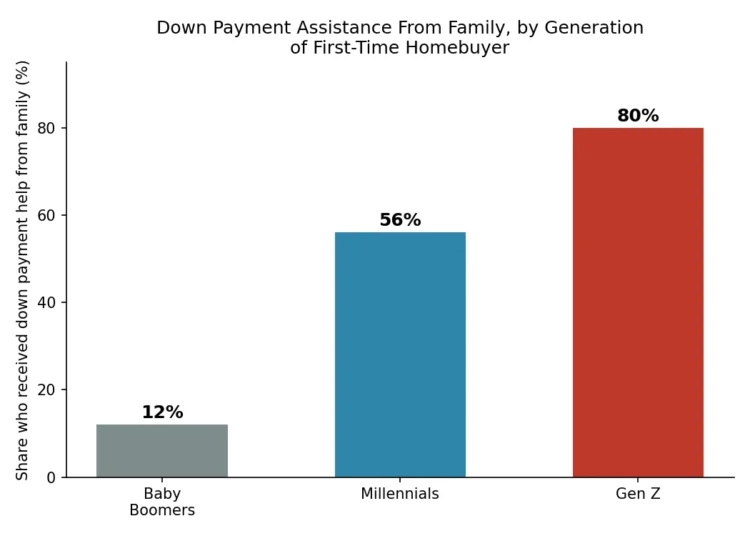
Bar chart titled “Down payment assistance from family, by generation of first-time homebuyer,” showing baby boomers at 12%, millennials at 56%, and Gen Z at 80%.
On the assistance itself, Wells Fargo’s 2026 Money Study adds a demand-side data point: 64% of parents with Gen Z children ages 18–28 say those children currently rely on them financially in some form, whether cash, housing, or other support (Wells Fargo Newsroom, 2026). That figure captures ongoing support, not just one-time purchase help, suggesting the Bank of Mom and Dad operates less like a single withdrawal and more like a standing credit line many families draw on repeatedly through a child’s twenties.
Implications
The practical implication for young adults is that homeownership and, increasingly, a debt-manageable college education have become partly a function of family balance sheets rather than individual income and savings discipline alone. That reframes a familiar personal-finance question — that we’ve explored in why personal finance is dependent upon your behavior — because budgeting discipline, however important, cannot close a gap measured in tens of thousands of dollars against a $414,900 median home price. For young adults without family capital available, the realistic response is not simply saving harder under a standard framework; readers navigating this should see our breakdown of when the 50/30/20 rule isn’t the best saving strategy for alternatives suited to a higher cost-to-income ratio.
For parents extending help, the shift from gift to loan matters financially and legally; family loans that aren’t formally documented can create tax and repayment ambiguity, and readers considering that route should review the fundamentals in how to manage a personal loan before treating an informal family arrangement the same as a handshake deal.
For policymakers, the data suggests that tightening federal aid — such as the July 2026 Parent PLUS caps removing income-driven repayment access — shifts risk toward informal, undocumented family lending precisely as formal lending options narrow, a substitution effect worth tracking rather than treating the policy change in isolation. For researchers and students, the clearest quotable finding here is this: family wealth transfer in the US is now concentrated enough, and large enough in scale, that it functions as a parallel and largely untaxed channel of opportunity distribution running alongside — and increasingly outweighing — labor income as a determinant of major life milestones.
Counterpoints and Limitations
This analysis has clear boundaries. It relies on multiple surveys with different definitions of “financial help” — some count only cash gifts toward a down payment, others include co-signing, rent-free living, or informal loans — so cross-survey comparisons (Gen Z at 80% in one survey versus 38% in another, both cited above) should be read as measuring somewhat different things rather than contradicting each other outright. It also does not model regional variation: family assistance rates and housing affordability pressure differ substantially between high-cost coastal metros and more affordable regions, and this piece treats the US as a national aggregate.
The wealth transfer projections extending to 2045 are long-run estimates sensitive to market performance, tax policy, and mortality assumptions that could shift considerably over two decades; they should be read as a scenario, not a certainty. Finally, this piece does not take a position on whether increased parental financial support is, on net, good or bad policy — reasonable people disagree on whether the right response is taxing intergenerational transfers more heavily, expanding public support for first-time buyers and students, or leaving family transfers untouched as a private matter. The data here documents the scale of the phenomenon; it does not resolve that normative debate.
Conclusion
The evidence supports a specific claim: parental financial support has moved from a supplemental advantage to something close to a structural precondition for hitting traditional American milestones, driven by a housing and education cost structure that has detached from what individual income can support, and amplified by a historically large, historically concentrated transfer of wealth now underway between generations. This isn’t entirely a new phenomenon — family money has always shaped opportunity, and sociological research suggests earlier generations simply talked about it less — but the scale, measured in an 80% assistance rate among Gen Z first-time buyers and a home-price-to-income ratio nearly double the affordability threshold, is different enough to justify calling this a distinct economic era rather than a continuation of the old one.
The open question is what happens to the roughly one-fifth to one-half of young adults — depending on the survey — whose families have no capital to offer at all. If family wealth continues to substitute for public and market-based paths to homeownership and education, the milestone gap between those with and without a Bank of Mom and Dad may become one of the defining fault lines of American economic life over the next decade.
FAQ
What percentage of Gen Z homebuyers get financial help from their parents?
About 80% of Gen Z first-time homeowners received down payment assistance from family, according to a 2026 LendingTree survey, up from 56% of millennials and 12% of baby boomers at the same life stage. A third of Gen Z recipients say they couldn’t have purchased a home without that help.
What is the “Bank of Mom and Dad”?
It’s a term for parents and grandparents providing cash gifts, loans, co-signing, or free housing to help adult children afford major costs like a home down payment or college tuition, distinct from a formal inheritance received after death.
How much wealth will change hands in the Great Wealth Transfer?
Baby boomers and the Silent Generation are projected to bequeath $84.4 trillion in assets through 2045, with $72.6 trillion passing directly to heirs, and roughly 55% of that activity concentrated between 2026 and 2036.
Is parental financial help a new trend, or has it always existed?
Family financial support has long shaped economic opportunity, but researchers say its scale has grown sharply while public acknowledgment of it has lagged behind meritocratic self-narratives — meaning the mechanism is old, but current dependency levels are historically high.