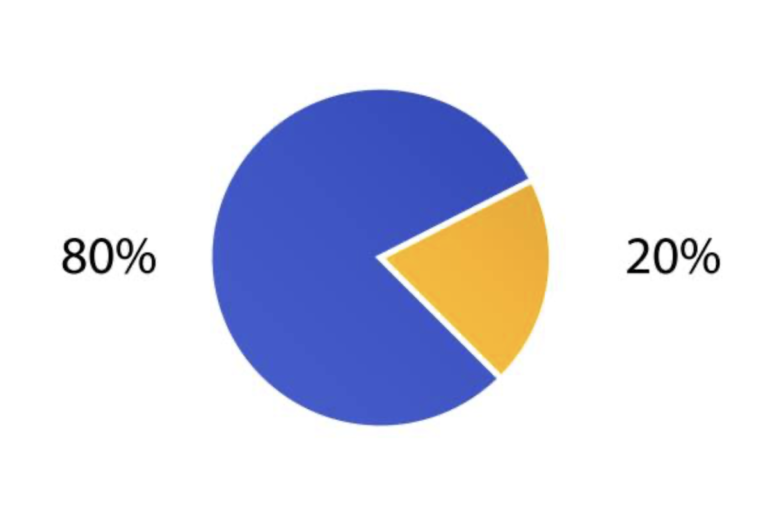
The average FICO Score in the United States held steady at 714 in FICO’s August 2026 Credit Insights Report — barely moved from a year earlier. On its own, that single number looks like a story about stability. It isn’t. Underneath that flat national average, FICO’s own data shows two very different things happening at once: a growing share of consumers are pulling ahead with excellent credit, while a shrinking group at the bottom is falling further behind, carrying rising balances and rising delinquencies. Economists have a name for this pattern: a K-shaped divide, where the same average conceals two opposite trend lines.
Here’s what FICO’s latest data actually shows, why the “average” credit score is a less useful number than it looks, which generations are gaining ground fastest, where real financial stress is concentrated, and the specific, unglamorous steps that reliably move a credit score in the right direction.
Key Takeaways
- The national average FICO Score was 714 as of FICO’s August 2026 Credit Insights Report, unchanged since October 2025 and down just 1 point year-over-year.
- 48.1% of consumers now have a score of 750 or higher, up from 43.3% in 2019 — but that gain is concentrated at the top, not spread evenly across all borrowers.
- Delinquencies are a mixed picture by loan type: early-stage mortgage delinquency actually improved year-over-year (1.42% to 1.35%), and auto delinquency ticked down 5 basis points to 2.6%, while credit card and personal loan delinquency were largely unchanged.
- Gen Z posted the largest score gains of any generation — up 17 points since before the pandemic — with Millennials up 10 points, even as both generations use Buy Now, Pay Later services at roughly twice the rate of Gen X and Baby Boomers.
- The real financial stress in the data is concentrated among subprime borrowers (FICO Scores below 620), where mortgage balances are up 43% and auto loan balances are up 36% since April 2019, and where delinquency increases are heavily concentrated.
The Average Credit Score in 2026: 714, and Why That Number Undersells the Real Story
FICO’s Credit Insights Report, published twice a year using a sample of the roughly 232 million US consumers with an active credit file, puts the national average FICO Score at 714 as of its most recent August 2026 release. That figure has essentially flatlined: it hasn’t moved since October 2025, and it’s down just a single point compared to a year earlier. Taken by itself, “the average credit score barely changed” sounds like a non-story.
The more revealing number sits one layer below the headline average. According to FICO, 48.1% of consumers now carry a score of 750 or higher — the range lenders generally treat as their best-rate tier — up from 43.3% in 2019. That’s a meaningful improvement at the top of the distribution. But because the national average has barely moved while the share of people at the very top has grown, the math only works one way: a corresponding group is not sharing in that improvement, and in some cases is sliding backward. Ethan Dornhelm, FICO’s head of scores analytics, described the resulting picture as “a credit market that’s both more challenging for some and more rewarding for others” — which is a more precise description of 2026’s credit environment than any single average score can offer.
Delinquencies: Better News Than Headlines Suggest, With One Notable Exception
A lot of consumer-debt coverage in 2026 has leaned on doom-laden framing, but FICO’s actual delinquency data by loan type tells a more mixed, and in some categories more encouraging, story than the headlines imply.
| Loan Type | What Changed Year-Over-Year |
|---|---|
| Mortgage (early-stage delinquency) | Improved, from 1.42% to 1.35% |
| Auto loans (30-day delinquency) | Improved 5 basis points, to 2.6% |
| Credit cards | Largely unchanged |
| Personal loans | Largely unchanged |
| Student loans | Rose only marginally in the report’s most recent measurement window, after sharp increases earlier in 2025 |
Two things stand out. First, mortgage delinquency — often treated as the scariest number in consumer credit because of what it signaled in 2008 — actually improved slightly. Second, and more important for understanding where real stress is building: FICO’s report is explicit that delinquency increases are not evenly distributed. They are heavily concentrated among the lowest-scoring borrowers, a pattern that lines up directly with the K-shaped framing above.
The Squeeze on Subprime Borrowers
The clearest evidence of where financial pressure is actually concentrated in 2026 shows up when FICO isolates borrowers with scores below 620 — the subprime tier lenders treat as highest-risk. Since April 2019, that group has seen mortgage balances rise 43% and auto loan balances rise 36%, a far steeper climb than higher-scoring tiers have experienced over the same period. FICO’s report also notes that delinquency increases have been concentrated almost exclusively in these lowest score bands, rather than spread broadly across the borrowing population.
Read alongside the earlier point about 48.1% of consumers now sitting above 750, the picture becomes clearer: this isn’t a credit market where everyone is doing slightly better or slightly worse together. It’s one where a majority of borrowers are managing debt about as well as, or better than, they were before the pandemic, while a smaller group is absorbing meaningfully larger balances and more of the delinquency risk. That’s also consistent with the elevated borrowing costs covered in our breakdown of what the Fed’s 2026 rate decisions mean for savings, debt, and mortgages: when credit card and personal loan rates stay elevated, the cost of carrying a balance falls hardest on borrowers who are already carrying more of one.
The Generational Divide: Younger Borrowers Are Gaining Fastest — With a BNPL Wildcard
One of the more counterintuitive findings in FICO’s 2026 data involves age. Gen Z posted the largest FICO Score gains of any generation since before the pandemic — up 17 points — with Millennials close behind at up 10 points. That runs against a common assumption that younger borrowers, often carrying student debt and entering the workforce during a higher-rate environment, would be under the most credit pressure. FICO’s March 2026 report adds a related data point: more than 25% of Gen Z consumers with a valid FICO Score opened at least one new credit card in the past year, the highest rate of any age group — suggesting younger borrowers are actively building credit history rather than avoiding it.
The wildcard sitting alongside that improvement is Buy Now, Pay Later usage. FICO’s data shows Gen Z and Millennials are roughly twice as likely to use BNPL services as Gen X and Baby Boomers — 66% and 57%, respectively, compared with 32% and 16%. BNPL loans have historically not always been reported to the credit bureaus in the same way traditional installment debt is, which means today’s credit-score gains for younger borrowers may not yet fully reflect how BNPL balances behave over a full economic cycle, including how consistently they get repaid once a household hits a rough stretch. It’s a trend worth watching rather than a confirmed problem — but it’s also exactly the kind of blind spot that shows up in hindsight rather than in real time.
How to Improve Your Credit Score in 2026
Regardless of which side of the K a given household sits on, the mechanics of a FICO Score haven’t changed, and they respond to the same basic inputs they always have:
- Pay on time, every time. Payment history is the single largest factor in a FICO Score. A single 30-day-late payment can stay on a credit report for up to seven years and do more damage than almost anything else on this list.
- Bring credit utilization down, especially on revolving accounts. Keeping card balances well below their limits — many advisors suggest under 30%, with the biggest gains often coming below 10% — is the second-biggest lever most people can actually pull in under a year.
- Don’t close your oldest credit card. Length of credit history matters, and closing a long-held account can shorten your average account age and reduce total available credit at the same time — a double hit to utilization and history.
- Limit new credit applications to what you actually need. Each hard inquiry has a small, temporary impact, and opening several new accounts in a short window (a pattern FICO’s Gen Z data shows is already common) compounds that effect.
- Treat Buy Now, Pay Later like real debt, because it is. Track BNPL payments with the same discipline as a credit card bill — automate them if the provider allows it — since missed BNPL payments can now be reported to credit bureaus depending on the lender.
- Check your credit report at each of the three bureaus at least once a year through AnnualCreditReport.com, the only federally authorized free source, and dispute any errors directly with the bureau reporting them.
None of these steps are new or exotic, and that’s the point: FICO’s own data shows the borrowers pulling ahead in 2026 aren’t doing anything unusual — they’re consistently doing the ordinary things well over a long period, which is also why the gap between the two ends of the K tends to widen rather than close on its own. For a related, more immediate lever, our guide to 2026’s confirmed 401(k) and IRA contribution limits covers how retirement-account decisions interact with a household’s broader debt-versus-savings math this year.
Frequently Asked Questions
What is the average credit score in 2026?
The national average FICO Score was 714 as of FICO’s August 2026 Credit Insights Report, essentially unchanged since October 2025 and down just 1 point from a year earlier.
Is a 714 credit score good?
Yes. FICO Scores generally range from 300 to 850, and 714 falls within the “good” range (typically 670–739), qualifying most borrowers for reasonable, though not the very best available, rates on credit cards, auto loans, and mortgages.
Why is the average credit score flat if more people have scores above 750?
Because the gains at the top of the distribution are being offset by rising balances and delinquencies concentrated among lower-scoring borrowers, particularly those below 620. FICO and industry analysts describe this as a “K-shaped” credit market rather than one moving uniformly in either direction.
Which generation has the best credit score trend in 2026?
Gen Z posted the largest FICO Score gains of any generation since before the pandemic, up 17 points, followed by Millennials at up 10 points — though both generations also use Buy Now, Pay Later services at roughly twice the rate of older generations, a trend FICO flags as worth monitoring.
Does Buy Now, Pay Later affect your credit score?
It can, depending on the provider and how a specific loan is structured and reported. Some BNPL lenders report to the major credit bureaus while others do not, and reporting practices are still evolving industry-wide, so consumers should check with their specific BNPL provider rather than assume it behaves like a traditional credit account.
The Bottom Line
The average FICO Score of 714 is real, but it’s also the least interesting number in FICO’s 2026 data. The more useful story is underneath it: a growing majority of consumers with strong, improving credit, and a smaller group of subprime borrowers absorbing steeper balance growth and nearly all of the recent delinquency increases. Whichever side of that divide a household is on, the tools to move a score in the right direction remain the same unglamorous basics — on-time payments, low utilization, and a long, undisturbed credit history — applied consistently over time rather than chased all at once.
This article is for general informational purposes only and does not constitute personalized financial advice. Credit scoring models, lender criteria, and reported statistics are subject to change; consult a certified financial planner, non-profit credit counselor, or your own credit report before making borrowing or credit decisions. Data current as of the FICO Credit Insights Reports published March 24, 2026, and August 25, 2026; this article was last updated September 27, 2026.