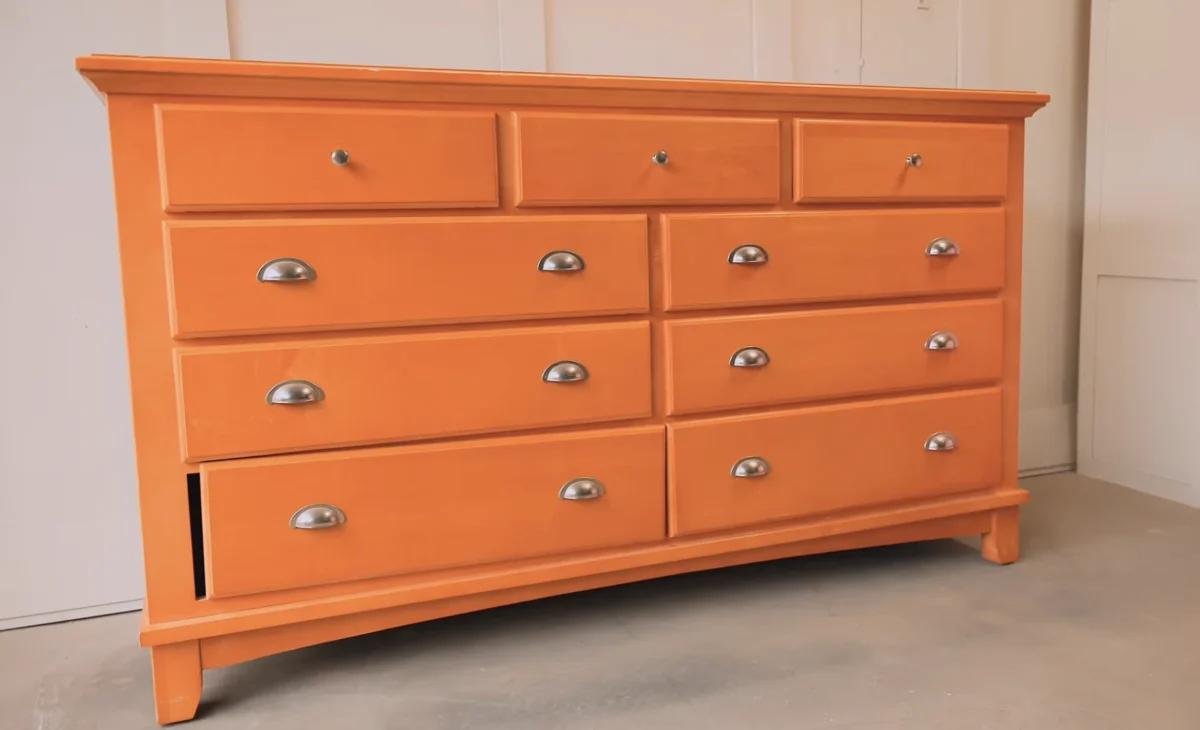
In April 2020, Kara Ward and her husband stood in the bedroom of a home they had purchased just five months earlier, and he told her he had lost his job — no severance, no warning, nothing. Six years later, that same homeschooling mom of two teenagers runs a furniture-flipping operation generating roughly $16,000 a month, has appeared on Dave Ramsey’s show, collaborated with MrBeast on a charitable water initiative, and built a YouTube channel that itself became one of her largest sources of income.
This is the real story behind one of the internet’s most popular side hustles — including the genuine numbers, the sourcing tactics, and an honest look at whether furniture flipping is actually as accessible as the most viral videos make it look.
From Job Loss to “Literal Gold in the Garage”
Kara Ward’s entry into furniture flipping had nothing to do with entrepreneurship and everything to do with survival. Her husband worked in the events industry, a sector that was among the hardest hit when COVID-19 shutdowns began, and he was among the first employees let go. The timing was brutal: the family had just moved into a new home, had two teenage children to support, and was already carrying roughly $60,000 in medical debt.
Like many people during that period, the couple turned to furniture restoration videos on YouTube partly as a distraction from the stress of the moment. That weekend, they painted a piece of their own bedroom furniture and posted photos to Facebook simply to show friends and family what they’d accomplished. The response was immediate: people began messaging, asking if Ward could refinish furniture for them too.
What started as informal commission work for friends gradually became a structured business. Within about six months of working at a rapid pace — Ward estimates the couple was completing five to six pieces a week out of their garage during the most intense early stretch — they realized they were making real, measurable progress against the debt that had been hanging over them. “We were really chipping away at this debt that we’ve had over our heads for a long time,” Ward has said, describing the moment the couple paused to recognize what their new side project had actually accomplished.
The Moment That Changed Everything
After their first year in business, having earned approximately $80,000, Ward made a simple sign documenting how much debt they’d paid off and posted a photo of it, along with her husband, to her personal Instagram account. The next morning, a producer from Dave Ramsey’s media team reached out, asking if the couple would travel to Nashville to film an episode about their story.
Ward recalls being genuinely confused by the producer’s specific request: “Are you filming what’s in your garage?” She didn’t initially understand why anyone would want footage of her workspace. The response she received reframed the entire opportunity: “You have literal gold in your garage. People need to hear this story.” That conversation prompted Ward to pick up a camera for the first time and start documenting her furniture flips for YouTube — a channel that, according to independent reporting, grew to roughly 150,000 subscribers and became monetized within five months of launching.
The channel’s growth opened doors well beyond furniture sales. Ward’s most notable brand collaboration came through MrBeast’s Team Water initiative, in which she flipped a piece of furniture and donated the resulting proceeds to the cause, while encouraging her own audience to do the same.
What Furniture Flipping Actually Means
For anyone unfamiliar with the concept, furniture flipping is straightforward in principle: sourcing furniture that is free, deeply discounted, or otherwise undervalued — from curbside finds, estate sales, thrift stores, and donation centers like Habitat for Humanity ReStore — restoring or refinishing it, and reselling it at a significant markup, typically through platforms like Facebook Marketplace.
Ward’s specific sourcing strategy targets a defined sweet spot: nightstands and dressers consistently perform as her best sellers. Her general rule is to avoid paying more than $80 to $100 for a dresser, even though her finished dressers often sell for $800 to $1,200 — a return that, on the high end, represents roughly a 1,000% to 1,500% markup on the initial purchase price.
The Era That Matters Most: 1960s Through 1980s
Ward has a specific preference for furniture manufactured between the 1960s and 1980s, and her reasoning reflects genuine material knowledge rather than aesthetic nostalgia alone. Furniture from this period was generally built from solid wood with quality construction, giving it what she describes as “good bones” — a sturdy foundation that holds up well to sanding, repainting, and structural repairs. Furniture manufactured after this period increasingly incorporated cheaper materials like laminate and particle board, which do not respond as well to the refinishing techniques that make older pieces profitable to restore.
The Numbers Behind a Single Flip
To illustrate the actual economics involved, Ward walked through a real, beginner-level flip from start to finish: an aged 1990s solid wood dresser, purchased for $30.
The supporting supplies for that single flip totaled $65 — a $25 can of furniture paint and $40 in new hardware, bringing the all-in cost to $95. After roughly six hours of hands-on work — cleaning, sanding, painting two coats, and reassembling with new hardware — the finished piece was listed on Facebook Marketplace for $750, attracted three interested buyers within 24 hours, and sold at the full asking price within days.
The resulting math: a $665 profit on a $95 investment, representing approximately a 700% return, and an effective hourly rate of roughly $110 for the hands-on labor involved — though it’s worth noting that drying time between coats (often several hours per coat) extends the total project timeline well beyond the active labor hours alone.
An Even More Extreme Example: The $11 China Hutch
Among Ward’s most striking sourcing stories involves a china hutch she found abandoned and free for the taking. The piece had two distinct components — a hutch top and a separate base — that, once restored, ended up looking different enough from one another that Ward sold them to two separate buyers rather than as a matched set. The combined sale generated more than $3,000 from a piece that cost essentially nothing to acquire.
A similar story involves an entire bedroom suite found discarded on a curb: a large dresser that sold for roughly $800 to $850, paired with a set of king-size nightstands that together brought in approximately $1,100 — a meaningful total return on furniture that, again, cost the business nothing beyond Ward’s own time and material costs to restore.
A Month-by-Month Income Breakdown
One of the more genuinely useful aspects of Ward’s public account is the level of financial transparency she provides about her current, multi-stream business. As of a recent month in 2026, her total monthly revenue across all income sources reached approximately $16,000, broken down as follows:
Kara Ward’s Monthly Income Breakdown
| Facebook ad performance/affiliate | $1,000 |
| Affiliate sales (Amazon, Lowe’s, etc.) | $2,000 |
| Brand sponsorship deals | $3,000 |
| Furniture sales | $4,000 |
| YouTube ad revenue | $6,000 |
| Total Monthly Revenue | ~$16,000 |
Against that revenue, Ward’s monthly costs include approximately $2,160 in employee wages (she employs five people to help manage the social media and operational side of the business), roughly $240 to $300 in supplies, and approximately $2,800 in furniture acquisition costs (purchasing about five pieces per month at her typical $80 ceiling per piece). Total monthly costs land at roughly $2,860, leaving an estimated monthly profit of approximately $13,140.
Critically, Ward has been explicit that furniture flipping itself — without any of the social media monetization — remains a genuinely viable business on its own. She describes consistently earning roughly $4,000 a month from furniture sales alone, which she characterizes as equivalent to a solid part-time job’s worth of income, achievable without ever building an audience or filming content.
How Pricing Actually Works
Determining what to charge for a finished piece is, by Ward’s own account, one of the trickier skills to develop, particularly for beginners. Her primary research method involves searching her local Facebook Marketplace using keywords like “dresser,” “bookshelf,” and “nightstand” to see what other flippers in her area — and there are typically several in any reasonably sized market — are charging for comparable pieces, then calibrating her own price against that local benchmark while factoring in the time and materials she’s invested in a given piece.
Ward has also emphasized a critical mindset shift required to price effectively: personal taste has to be set aside entirely. “You can’t think about what you like at all,” she has stated, noting that she regularly creates finished pieces she personally wouldn’t choose for her own home, because her job is designing for buyers’ taste and current market trends rather than her own preferences. Her research process for staying on top of those trends includes regularly browsing retailers like Pottery Barn and other furniture stores to identify currently popular colors, finishes, and silhouettes that she can replicate at a fraction of retail pricing.
Upgrades Worth Making — and Skipping
Not every potential upgrade to a piece delivers proportional value. Ward has identified swapping out hardware — drawer pulls, handles, and knobs — as one of the highest-return investments available, since it’s a relatively small cost that meaningfully modernizes an otherwise dated piece. Conversely, she has found that painting the interior of cabinets and drawers — areas buyers rarely scrutinize closely — does not meaningfully affect the final sale price, making it a step worth skipping to save time.
What It Actually Costs to Get Started
For anyone considering furniture flipping as a genuine side hustle, Ward’s guidance on startup costs is reassuringly modest. She estimates a complete beginner can get started for approximately $100 to $115, covering an entry-level orbital sander (the single most important tool, available starting around $59), a quality paintbrush, a can of furniture-grade paint, and a basic all-purpose cleaner — with options as simple and inexpensive as dish soap serving as an adequate substitute for specialized cleaning products when starting out.
Paint represents one of the larger recurring costs, but Ward has noted a meaningful efficiency once a flipper settles on a reliable, trending color: a single gallon can typically produce four to five separate furniture flips, meaningfully reducing the effective per-project paint cost when purchased and used strategically across multiple pieces rather than buying smaller quantities repeatedly.
The Photography Step Many Beginners Underestimate
Ward has been direct that the photography and listing presentation stage is arguably the single most important part of the entire sales process — more consequential, in her assessment, than the quality of the restoration work itself in determining how quickly and profitably a piece sells.
Her staging setup is intentionally simple: basic garage lighting positioned to eliminate shadows regardless of weather or time of day, a thrifted area rug to help buyers visualize the piece in a furnished room rather than an empty garage, and a few inexpensive decorative props that get reused across many different listings. She has also begun incorporating AI image generation specifically for a listing’s primary cover photo — uploading a real photo of the finished piece into an AI tool with a prompt requesting it be shown in a styled setting such as a modern farmhouse entryway, while explicitly instructing the tool not to alter the furniture itself. All subsequent photos in a listing, however, are genuine, unedited images, which Ward considers essential given growing buyer awareness of AI-staged listings.
Beyond visual presentation, Ward emphasizes precise, keyword-rich listing titles and descriptions — explicitly including every plausible search term a buyer might use (for example, listing a single piece as a “credenza,” “buffet,” and “sideboard” simultaneously) along with complete dimensions, since incomplete measurements reliably generate a flood of repetitive buyer questions that slow down the sales process.
A Necessary Reality Check
Furniture flipping’s viral popularity has produced a wave of creators presenting dramatic profit numbers, and it’s worth pausing on a genuinely important counterpoint before treating this side hustle as an easy, guaranteed path to significant income.
Christina Muscari, whose own furniture-restoration YouTube channel directly inspired several other flippers now documenting their journeys online, has offered a more cautious perspective on the realistic earning potential of furniture flipping as a standalone business. In her own market, she has found there simply isn’t sufficient buyer demand for used furniture to generate substantial income from sales alone — meaning her own primary income source has consistently been YouTube content revenue rather than the furniture sales themselves, even though her channel is specifically about furniture restoration.
Muscari has also pointed out that many of the elaborate techniques showcased in flipping videos — extensive trim work, decorative details, time-intensive customization — are created primarily to generate engaging video content rather than because they meaningfully increase a piece’s resale value. Profitable furniture flipping, in her assessment, typically involves considerably less creative elaboration than what tends to perform well on camera. Her broader caution is direct: “Anybody who’s selling the idea that you can make so much money just flipping junk, I would just be wary of it because you have to do so much of it.” While she acknowledges genuine financial success is possible for flippers who become very skilled at the craft, she considers it a less common outcome than viral content might suggest, and notes that local market conditions — population density, local demand for secondhand furniture, and the number of competing flippers in a given area — significantly affect how realistic any individual’s results will be.
This perspective doesn’t invalidate Ward’s experience, but it does provide important context: furniture flipping’s profitability appears to vary considerably by local market, and the specific multi-stream income model Ward has built — combining furniture sales with YouTube revenue, brand sponsorships, and affiliate income — may be considerably more lucrative, and more replicable for a wider range of people, than furniture sales in isolation.
Practical Lessons for Anyone Considering This Side Hustle
Start with what you have, not what you think you need. Ward’s entire operation began with a single piece of bedroom furniture and zero prior restoration experience. The skills were developed through trial and error, largely using free YouTube tutorials, rather than any formal training.
Target solid wood furniture from the 1960s through 1980s specifically. This window represents a genuine sweet spot of quality construction that responds well to refinishing, without the cheaper laminate materials that became standard in many later decades of mass-produced furniture.
Set a firm acquisition price ceiling and stick to it. Ward’s discipline around not paying more than $80 to $100 for source pieces, even for items she finds personally appealing, protects her margin and ensures consistent profitability across her business rather than occasional lucky wins offset by overpriced purchases.
Treat photography and listing copy as a core skill, not an afterthought. The gap between a mediocre Facebook Marketplace listing and a genuinely compelling one can be the difference between a piece sitting unsold for weeks and selling within 24 hours at full asking price.
Be realistic about local market variation. What works in a large, design-conscious metro area like Dallas may not translate directly to smaller or less furniture-flipping-saturated markets. Researching local Facebook Marketplace activity before committing significant time or money is a reasonable first step for any beginner.
Consider the side hustle independent of any social media ambitions. Ward is explicit that the furniture flipping itself — without ever picking up a camera — remains a legitimately profitable business capable of generating meaningful supplemental income for those willing to put in the sourcing, restoration, and listing work.
Key Facts: Kara Ward’s Furniture Flipping Business at a Glance
| Founder | Kara Ward |
| YouTube channel | Lemons To Lemonade Home |
| Business origin | 2020 Following husband’s job loss during COVID-19 |
| Starting debt | ~$60,000 medical debt |
| First-year earnings | ~$80,000 |
| Current monthly revenue | ~$16,000 multi-stream |
| Monthly furniture-only revenue | ~$4,000 |
| YouTube subscribers | ~150,000 |
| Channel monetized | Fast track Within 5 months of launch |
| Notable collaborations | Dave Ramsey, MrBeast (Team Water initiative), Lowe’s (Top 100 Influencer Program) |
| Target source furniture era | 1960s–1980s, solid wood |
| Typical dresser acquisition cost | $80–$100 max |
| Typical dresser resale price | $800–$1,200 |
| Beginner startup cost | ~$100–$115 |
| Primary sales platform | Facebook Marketplace |
| Average flip timeline | ~3 days (mostly drying time); 6–8 hours hands-on |