Every successful product has an origin story, but few are as genuinely emotional as this one: a man who had to leave his dog behind when he moved to the United States, missing his companion so much that he asked his father to sew him a keepsake pillow shaped exactly like the dog he’d left. That single, deeply personal request became the foundation of All About Vibe, a Chicago-based company that now manufactures and ships up to 5,000 custom photo pillows a day and generates roughly $60 million in annual revenue.
This is the full story of how Oleg Lee built that business — from a single sewing machine older than he was, through a brutal first few years funded by maxed-out credit cards and a drained 401(k), to a sophisticated direct-to-consumer operation that has become one of the more instructive case studies in modern e-commerce.
A Pillow Born From Missing a Dog
Oleg Lee’s company, originally founded in 2016 under the name LifeLike Pillows before rebranding to All About Vibe, traces its origin to a deeply personal loss. After moving to the United States, Lee had to leave his beloved dog behind — an emotional void that he has described as the genuine catalyst for everything that followed. Hoping to feel close to his pet again, he asked his father to make him a pillow as a keepsake.
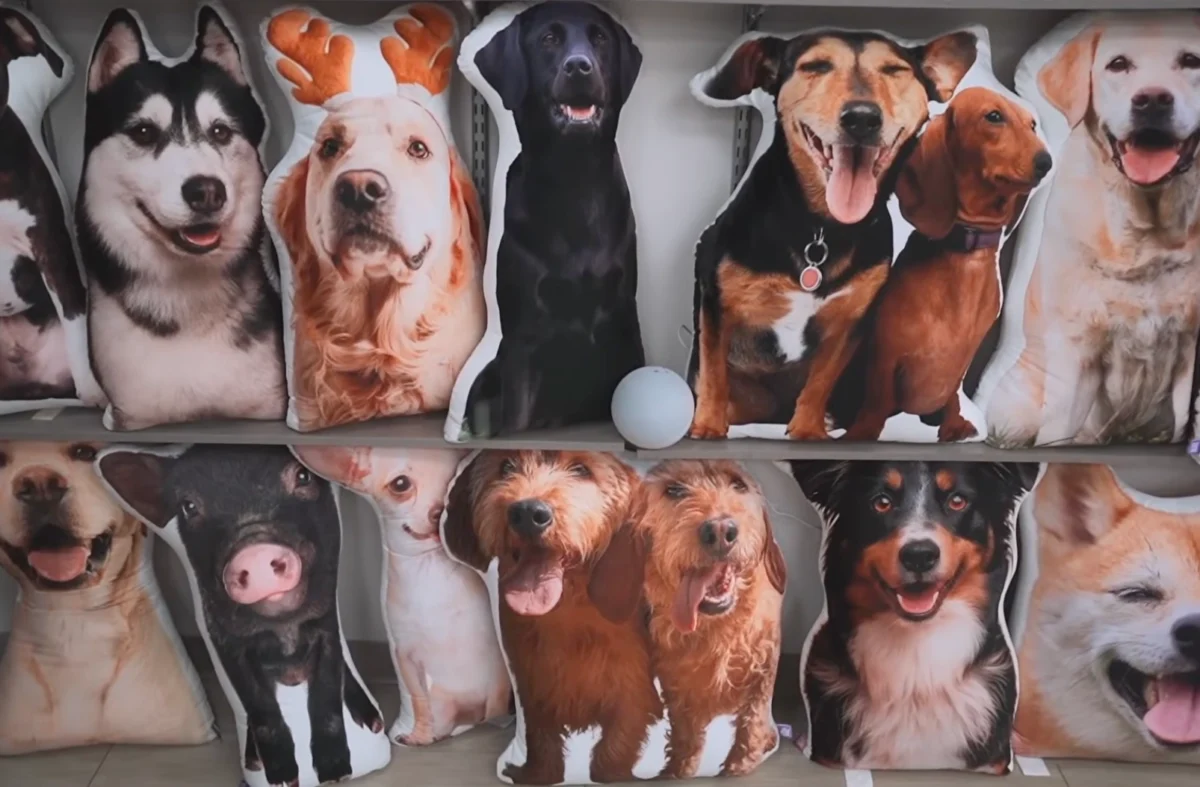
The first version was simple: a basic square pillow with a photo printed on it. But Lee wondered whether the pillow itself could be shaped to match his dog’s actual outline, rather than just printed on a generic rectangle. His father tried it. The result, in Lee’s own words, looked like an actual dog sitting there — startlingly lifelike, far beyond what either of them expected from a homemade project.
Lee photographed the finished pillow and shared it on social media, expecting little more than a few likes from friends. Instead, the reaction was immediate and overwhelming. People began messaging him directly, asking where he’d gotten it, whether he could make one of their own pet, and how the process worked. There was just one problem: at that point, Lee had no actual business, no repeatable process, and no clear plan for turning a one-off family project into a company that could fulfill real customer orders.
Why the Product Resonated So Deeply
Understanding why this particular product caught on so powerfully matters for anyone studying consumer behavior or product design. Lee has identified what he believes is the core emotional driver: the pillow’s custom shape is what creates the initial “wow” reaction, but it’s the fact that the product can be physically hugged that creates genuine emotional connection. Unlike a printed photo or a framed picture, a shaped, huggable pillow offers something almost no other personalized product category can: physical comfort tied directly to an emotional memory.
That distinction has shaped the company’s entire customer messaging strategy over the years. Rather than positioning the product purely as a novelty item, the team eventually understood that they were selling something closer to emotional comfort delivered through fabric — pillows that customers buy as gifts after losing a pet, as a way to feel close to someone during a long-distance relationship, or as a way to commemorate someone they haven’t seen in a long time.
The Brutal Early Years: Credit Cards, a Drained 401(k), and a Garage
The business’s first chapter was financially precarious in ways that many polished founder narratives tend to gloss over, but Lee has been unusually candid about exactly how close to the edge the operation ran.
The entire early operation was based in a car garage, equipped with a single sewing machine that Lee has described as older than he was at the time. As demand grew faster than the business’s ability to finance it, the financial strain became severe. The first year was, in Lee’s own description, brutal: the family maxed out their credit cards and his wife withdrew her entire 401(k) retirement savings just to keep the business operating and pay their bills. Lee has also described taking on side construction work during this period specifically to generate additional cash to keep the company afloat.
He has been candid that this was a genuinely difficult decision for his wife to make, and that she questioned the choice — understandably, given what was at stake — but ultimately continued to trust him and stayed involved as what he describes as the single biggest supporter of the business outside of his father, who had been there from the very beginning. Lee and his wife have now been together 22 years, and he credits a shared mission and shared purpose as a foundational source of strength through the company’s hardest stretches.
The Order That Changed Everything: 20,000 Pillows in Two Days
One of the most pivotal moments in the company’s early history came almost by accident. As Lee began searching for ways to pitch the product more broadly — attending trade shows and reaching out to potential commercial customers — he connected with a buying group and pitched them on the pillows, expecting, by his own account, to sell a few hundred units at most.
Instead, the group placed an order for 20,000 pillows, to be fulfilled within an extremely tight timeframe. Lee has described the experience candidly as “a nightmare,” not because the order itself wasn’t a win, but because the business had absolutely no infrastructure to produce that volume. There were no materials sourced at that scale, no trained staff, and no established production process capable of handling anything close to that number of units.
The response was pure resourcefulness. Lee mobilized his entire family and as many people as he could recruit. The team would purchase printed fabric from local print shops, bring it back to the garage, cut it into pieces, and have Lee’s father sew the shells — work that, by Lee’s account, took an extraordinary number of hours. Family members traveled to multiple Walmart stores across a roughly 20-mile radius specifically to buy enough polyester stuffing fiber, since no single store carried sufficient quantity. Every single pillow during this period was stuffed entirely by hand.
That order also opened an important door: it led to Amazon eventually agreeing to list and sell the product through Amazon Prime — a retailer that, by Lee’s account, had previously shown no interest in working with the still-unproven young company. That credibility, in turn, helped Lee secure a major retail deal that ultimately placed the product in roughly 3,000 stores.
The Pivot That Mattered Most: Abandoning Wholesale Entirely
If there is a single decision in All About Vibe’s history that most directly explains its growth into a genuinely large, profitable business, it is Lee’s decision to walk away from wholesale and marketplace retail entirely in favor of direct-to-consumer sales.
For years, the company operated primarily as a wholesaler, selling stock pillow designs — largely pre-made dog and cat shapes — to roughly 50 different retail and marketplace partners. That channel offered real exposure and volume, but it came with a structural problem that quietly strangled the business’s cash flow: wholesale and marketplace partners typically paid on extended payment terms, commonly 60 or even 90 days after an order shipped. Lee has noted that Walmart’s payment terms, in particular, stretched out even further, reaching as long as 180 days at certain points.
The practical consequence was brutal: the company often had to manufacture and ship large orders well before receiving any payment for them, creating a persistent cash crunch even when the underlying business was, on paper, growing. Lee has described situations where completed orders sat ready to ship but the company lacked even the cash needed to cover shipping costs.
Around the same time, a small but increasingly important direct-to-consumer channel — primarily fulfilling custom requests for people’s own pets, processed through Shopify — was generating dramatically better economics. Margins were higher, and critically, payment arrived within days rather than months, since Shopify deposits funds quickly compared to traditional wholesale invoicing.
Lee made the decision to abandon wholesale and marketplace sales entirely, in a single deliberate move: he informed his wife, his team, and his wholesale partners by email that the company was shutting down those channels for good. At the time, this meant walking away from a business generating roughly $2 million in annual revenue through wholesale — a genuinely risky bet, since the direct-to-consumer channel was still comparatively small.
The bet paid off decisively. Within two years of making the full pivot to direct-to-consumer sales, the company’s revenue grew from roughly $2 million to approximately $8 million — a fourfold increase driven entirely by the healthier-margin, faster-cash-flow custom order business. Lee has described this as the single best business decision he ever made.
Solving the Custom Order Bottleneck
Even after committing fully to direct-to-consumer custom orders, the company faced a significant operational challenge: how do you show a customer what their finished, custom-shaped pillow will actually look like before they commit to buying it, when every single order is genuinely unique?
The company’s first attempt involved charging a small upfront fee, then manually creating a design mockup and emailing it to the customer for approval before production began. This approach quickly became an unsustainable logistical burden, requiring the team to manage thousands of individual email exchanges and previews.
The solution took roughly a year to develop: an in-house mockup generator that allows customers to upload a photo directly to the company’s website and see a realistic 3D preview of their finished pillow in under three seconds. Lee has described this tool as the single biggest game-changer in the company’s ability to scale custom orders, since it eliminated the entire manual preview-and-approval bottleneck and let customers see exactly what they would receive before completing a purchase.
Becoming “The Pillow Guy”: Marketing Through Direct Celebrity Outreach
One of the more unusual and instructive elements of All About Vibe’s growth strategy involves Lee’s direct, unfiltered outreach to celebrities and influencers — an approach he has credited to studying the early playbooks of entrepreneurs like Daymond John and digital marketer Gary Vaynerchuk.
Lee’s method was straightforward: he would personally direct-message celebrities and influencers, often creating a finished custom pillow first — based on something he knew the person genuinely cared about, such as their child or pet — and then reaching out with the finished product already made, simply asking where to ship it. This approach, leading with a finished, personalized gift rather than a generic pitch, proved unusually effective at generating responses, even from public figures who would typically ignore a cold outreach message.
This strategy produced the moment that gave Lee his enduring nickname. He had previously made pillows for Daymond John’s office, and sometime later, Lee happened to step into an elevator in a random New York building and found himself face to face with John himself. Despite trying to play it cool, John immediately recognized him — not by name, but by product. “You’re that pillow guy, right? You made a pillow for our office?” That unplanned recognition, despite Lee wearing no branded clothing or company identification, cemented an identity he has fully embraced ever since: he is, by his own choice and acceptance, simply “the pillow guy.”
The World’s Largest Pillow: A 60-Foot Marketing Stunt
Among the company’s more memorable brand-building moments was a deliberate publicity stunt built around a recurring customer question: what’s the biggest pillow you can actually make? Rather than simply answering the question, Lee decided to make the answer genuinely spectacular by setting out to create the world’s largest pillow.
The result was a 60-foot-tall body pillow created in collaboration with online creator David Dobrik, which the company has stated set a world record for the largest pillow ever made. The stunt generated substantial attention and reinforced the brand’s core appeal — taking an everyday, intimate object and making it into something genuinely surprising and shareable.
The Numbers: A Transparent Look Inside a $60 Million Business
Among the most valuable aspects of Lee’s public account of the business is his willingness to share genuinely detailed financial figures — a level of transparency rare among founders discussing a company at this scale.
For 2025, the company’s website revenue reached approximately $13.5 million, while broader company-wide revenue across all channels was cited at closer to $40 million for the same period, with the business operating at a roughly $60 million annual run rate more recently. Breaking down the cost structure behind that revenue reveals an instructive picture of what it actually costs to run a manufacturing-heavy, marketing-intensive direct-to-consumer business:
All About Vibe: 2025 Cost Breakdown
| Cost of Goods Sold (materials) | $1.1 million |
| Shipping | $1.3 million |
| Marketing/Advertising | $5.8 million |
| Payroll | $2.2 million |
| Overhead, lease, fixed costs | $1.3 million |
| Net Taxable Income | ~$1.8 million |
The most striking figure in that breakdown is marketing spend, which at $5.8 million represents close to half of the company’s website-specific revenue — a number Lee has openly acknowledged is enormous, while noting that customer acquisition costs in digital advertising tend to rise over time rather than fall, making sustained marketing investment a permanent feature of the business rather than a temporary scaling cost.
The company sells more than 300,000 pillows annually, with year-over-year growth of roughly 35 to 40 percent, at an average ticket price of approximately $65 to $70. After accounting for advertising costs specifically — which the company has identified as the single largest drag on overall margin — the business operates at an estimated 20 to 25 percent net margin.
The Advertising Machine Behind the Growth
All About Vibe’s marketing strategy relies overwhelmingly on paid social advertising, primarily through Meta’s platforms (Facebook and Instagram), supplemented by Google ads and organic social content. At any given time, the company runs hundreds of active ad variations — reportedly more than 700 in typical periods, expanding to well over 1,000 during peak seasons like Mother’s Day.
Lee has described the underlying logic clearly: the product is fundamentally an impulse purchase. Nobody actively searches for a custom-shaped photo pillow before discovering one exists — but once someone scrolling through social media sees a compelling video of the product, genuine purchase interest follows quickly. This dynamic explains why the bulk of the company’s advertising budget goes to platforms built around passive scrolling and discovery, like Meta’s properties, rather than search-intent platforms.
Interestingly, Lee has noted a meaningful secondary effect from this Meta-heavy spending: increased visibility on Meta appears to correlate directly with increased search volume and purchases on Google, as potential customers who encounter the product in a social feed often research the brand independently before completing a purchase elsewhere. Organic traffic and social content account for a comparatively modest share of total orders — roughly 20 percent of the company’s order volume, with the remainder split between Meta-driven and Google-driven purchases.
A significant share of the content fueling those ad campaigns comes directly from customers. The company runs an ongoing program offering a meaningful store credit incentive to customers who record and submit a genuine reaction video — typically someone receiving and opening a custom pillow as a gift — which the company can then use, with permission, across its advertising.
From Garage to Factory: The Manufacturing Evolution
The physical transformation of All About Vibe’s production capability mirrors its financial growth. What began with a single print station, a single heat press, a single cutting table, and a single sewing machine has expanded into a Chicago-based facility spanning roughly 20,000 square feet, capable of producing and shipping up to 5,000 pillows in a single day.
The manufacturing process itself follows a defined sequence: a customer’s uploaded photo is reviewed and edited by an in-house design team — Lee has indicated the company employs a team of six to seven designers, each processing several hundred images per day — before the finished design is printed onto fabric and transferred through a heat-based sublimation process that permanently bonds the ink into the material, making the final product fully machine washable. From there, pieces are cut, aligned, and sewn, then turned inside out, stuffed using an industrial fiber-opening and filling system, sewn closed, and prepared for shipping.
Lee has emphasized that the company continuously analyzes its own production process specifically to identify and eliminate small inefficiencies, framing the goal explicitly around making the product as quickly as possible while never compromising on quality.
Lessons for Aspiring Entrepreneurs
Several principles from All About Vibe’s growth apply directly to anyone building a product-based business from limited resources.
A single, deeply personal problem can reveal a genuinely large market. Lee’s pillow began as a way to address his own grief over leaving a pet behind — not as a calculated market opportunity. The strongest product ideas often emerge this way: solving a real, specific, personal problem turns out to resonate with a far larger audience experiencing some version of the same need.
Wholesale revenue and healthy revenue are not the same thing. A business can show meaningful top-line revenue through wholesale or marketplace channels while quietly being strangled by extended payment terms. Evaluating any growth channel requires looking specifically at cash flow timing, not simply gross sales volume.
Sometimes the boldest move is walking away from existing revenue. Lee’s decision to abandon an established $2 million wholesale business in favor of an unproven, smaller direct-to-consumer channel required real conviction, given the obvious risk involved. The willingness to make that trade, based on a clear-eyed read of unit economics rather than top-line comfort, was the single decision most responsible for the company’s subsequent growth.
Direct, personal outreach can outperform conventional marketing, especially early on. Lee’s strategy of creating finished, personalized products for influencers and celebrities before ever asking for anything in return proved more effective than a conventional advertising pitch would likely have been at the same stage of the business.
Operational discipline matters as much as marketing creativity. The company’s continuous, granular process improvement — examining each step of manufacturing for small efficiency gains — reflects a discipline that is easy to overlook in founder narratives focused primarily on marketing wins, but which is equally responsible for the company’s ability to actually fulfill demand at scale.
Key Facts: All About Vibe at a Glance
| Company name | All About Vibe (formerly LifeLike Pillows) |
| Founder | Oleg Lee (with father and wife as key early collaborators) |
| Founded | 2016 |
| Headquarters/Factory | Chicago, Illinois |
| Annual revenue (recent) | ~$60 million run rate; ~$13.5M website revenue (2025) |
| Pillows sold annually | 300,000+ |
| Average order value | ~$65–$70 |
| Net margin | ~20–25% |
| Annual marketing spend | ~$5.8 million |
| Active ads running | 700+ (1,200+ during peak season) |
| Production capacity | Up to 5,000 pillows/day |
| Notable marketing stunt | World record World’s largest pillow (60 ft), with David Dobrik |
| Notable celebrity connection | Daymond John (“the pillow guy” origin story) |
| Key pivot | $2M → $8M Full exit from wholesale/marketplace to direct-to-consumer (2-year period) |