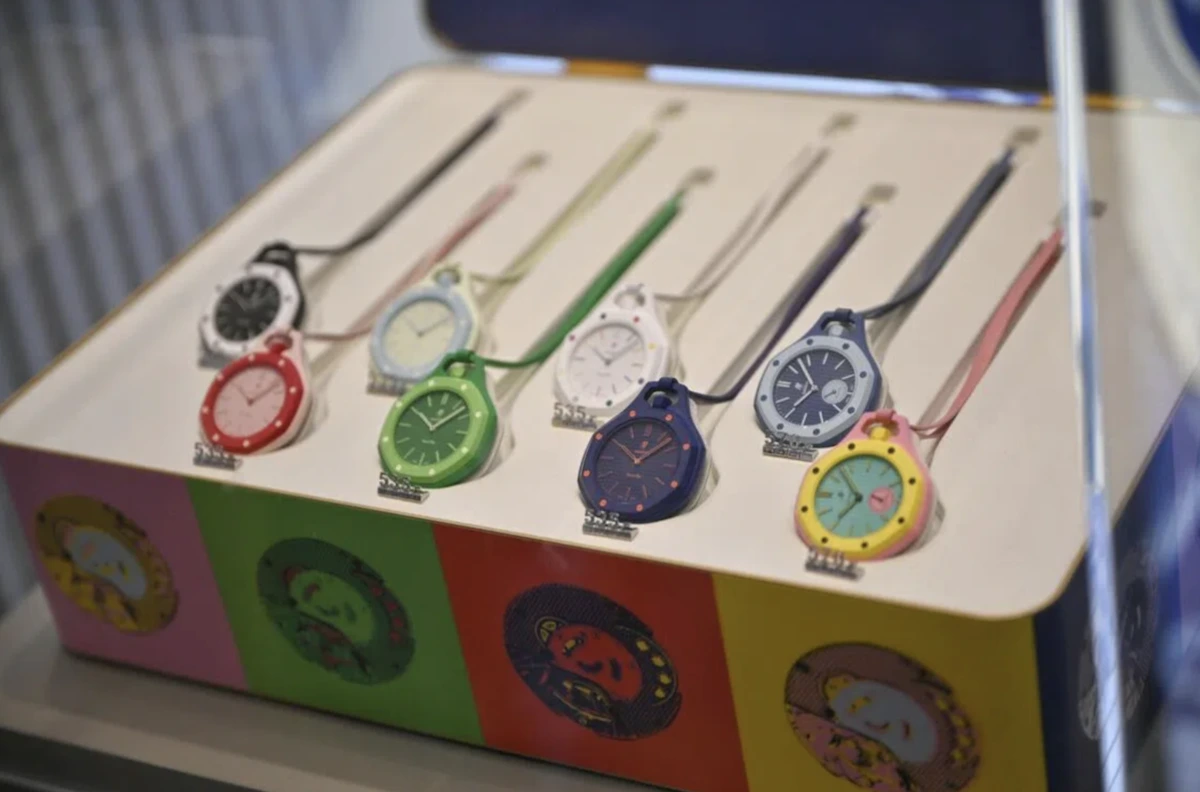
When the Swatch × Audemars Piguet “Royal Pop” collection triggered overnight queues at luxury malls, something interesting happened: a watch launch stopped being a product event and became a behavioral experiment in real time.
People weren’t just buying timepieces. They were participating in a system of scarcity, identity, and collective excitement that reveals how modern markets actually work when emotion overrides logic.
This case sits at the intersection of luxury marketing, behavioral economics, scarcity strategy, social signaling, community psychology, and hype culture—and it offers lessons far beyond the watch industry.
1. Scarcity Marketing (Limited Supply = Higher Demand)
Scarcity is one of the most reliable drivers of perceived value in consumer behavior.
When a product feels difficult to obtain, the brain automatically upgrades its importance. Not because it is objectively better, but because access itself becomes a signal of worth.
In the Swatch × Audemars Piguet launch, scarcity was not subtle—it was structural:
- limited physical store drops
- strict purchase limits per person
- unclear stock availability
- requirement to be physically present
The result was predictable: overnight camping, long queues, and growing urgency fueled by fear of missing out.
What is important here is not just demand, but visibility of demand. The queue becomes proof that value exists.
For businesses, scarcity is not just about limiting supply. It is about shaping perception:
- If it feels rare, it feels valuable.
- If it feels uncertain, it feels urgent.
- If it feels exclusive, it feels desirable.
This logic is widely used in sneaker drops, gaming skins, collectibles, and limited-edition fashion releases.
2. Veblen Goods & Luxury Signaling
Luxury products often behave like Veblen goods—where desirability increases with exclusivity and perceived status.
But the deeper layer is not price. It is signaling.
Owning something from the Swatch × Audemars Piguet collaboration communicates more than taste. It signals:
- insider access
- cultural awareness
- participation in a moment
- belonging to a specific consumer tribe
The phrase “subtle luxury” captures this shift well. Modern consumers are moving away from loud branding and toward coded recognition—where only certain people understand what something represents.
This transforms the watch into a social instrument rather than a functional object.
For businesses, this means products can operate as:
- identity markers
- status signals
- cultural membership tokens
The value is no longer just in the object, but in what others infer about the owner.
3. Social Proof & Herd Behavior
When people are uncertain, they look to others for guidance. This is social proof in action.
A long queue is one of the most powerful forms of marketing because it answers a silent question instantly:
“Is this worth it?”
The answer becomes visible in human behavior.
In this launch, the queue itself became a demand amplifier. Even individuals who had not decided what they wanted still joined because:
- others were joining
- attention was increasing
- value felt externally validated
This creates a feedback loop:
more people → more perceived value → more people
At that point, marketing is no longer controlled by the brand. It is controlled by the crowd.
Businesses can engineer this effect through:
- visible waitlists
- limited slots
- public demand indicators
- user-generated hype content
4. Experiential Consumption
A growing segment of consumers no longer buys products only for utility. They buy experiences.
This launch made that explicit. Many participants were not purely motivated by ownership. They were motivated by participation.
Waiting overnight became:
- a story
- a memory
- a social experience
- a form of entertainment
In that sense, the queue was part of the product.
This is especially relevant for younger consumers who value:
- participation over possession
- experience over convenience
- community over transaction
For businesses, this suggests a major shift: selling should increasingly resemble event design.
5. Drop Culture & Hype Economics
Drop culture is a system where products are released in concentrated bursts rather than continuous availability.
Originally popularized by streetwear and sneaker brands, it has now entered luxury watch collaborations.
The Swatch × Audemars Piguet drop worked because it combined:
- surprise timing
- scarcity
- cultural relevance
- social amplification
Drops are powerful because they compress attention. Instead of slow interest building, they create a spike of urgency and collective focus.
This model often outperforms traditional retail because it:
- concentrates demand
- amplifies media coverage
- accelerates word-of-mouth
The downside is volatility—but that volatility is also what creates hype.
6. Collaboration Marketing (Brand Equity Transfer)
Collaborations work because they allow brands to exchange meaning.
In this case:
- Audemars Piguet contributes prestige, heritage, and exclusivity
- Swatch contributes accessibility, mass appeal, and cultural playfulness
The result is a hybrid positioning: aspiration meets accessibility.
This is strategically powerful because it expands both audiences:
- luxury consumers get novelty and cultural relevance
- mass-market consumers get proximity to luxury symbolism
For brands, collaboration is not just marketing—it is audience recombination.
7. Artificial Friction Increases Perceived Value
One of the most counterintuitive forces in consumer behavior is that effort increases perceived value.
Camping overnight, waiting in uncertainty, and enduring discomfort all create psychological investment.
This is tied to effort justification: if something is hard to obtain, the brain assumes it must be valuable.
In the queue scenario, friction included:
- physical exhaustion
- uncertainty about availability
- time investment
- social competition
The paradox is that the harder it was to get, the more desirable it became.
For businesses, this suggests that convenience is not always the goal. Controlled friction can strengthen emotional attachment.
8. Community Formation & Tribal Identity
At a certain point, the queue stops being a line and becomes a temporary society.
People share:
- time
- space
- uncertainty
- anticipation
This creates a short-lived but powerful community identity.
Humans are tribal by nature. When brands facilitate shared experience, they create:
- belonging
- identity reinforcement
- emotional loyalty
This is why modern brands increasingly resemble communities rather than product catalogs.
9. Secondary Market Economics
When scarcity is strong enough, a secondary market naturally emerges.
Products from drops like Swatch × Audemars Piguet often gain speculative value because:
- demand exceeds supply
- availability is time-limited
- resale potential is anticipated
This turns consumers into hybrid actors: part buyer, part investor.
However, this introduces tension:
- it increases hype
- but risks accessibility backlash
- and can distort brand perception
Still, from a market perspective, resale activity often reinforces perceived desirability.
10. Controlled Chaos as Viral Marketing
One of the most interesting elements of this launch was not just the queue—but the disorder within it.
Competing queue systems, informal numbering, and crowd tension created a narrative layer beyond the product itself.
Chaos generates:
- storytelling
- social media content
- emotional intensity
- media coverage
In modern marketing, structure and unpredictability can coexist. Too much control reduces emotional energy. A certain level of chaos increases cultural virality.
11. Emotional Utility vs Functional Utility
A watch tells time. But that is not why people queued overnight.
The real purchase was emotional:
- excitement
- identity
- status
- participation
- memory
This is a fundamental shift in modern consumption: functional value is no longer the main driver for premium demand.
Instead, emotional utility dominates high-demand markets.
Businesses that understand this shift stop competing on features—and start competing on meaning.
12. What Consumers Can Learn
Events like this expose how deeply psychology shapes purchasing behavior.
Key biases at work include:
- FOMO (fear of missing out)
- herd behavior
- scarcity bias
- emotional contagion
- identity-driven consumption
A useful reflection before purchasing in similar situations:
- Is the value coming from the product, or the moment around it?
- Would demand exist without the crowd?
- Is this ownership or participation I am seeking?
Understanding these mechanisms helps separate genuine preference from social influence.
Final Insight
The Swatch × Audemars Piguet launch shows that in modern markets, the most valuable product is often not the object itself.
It is:
- the feeling of access
- the identity signal
- the shared experience
- the scarcity narrative
- the cultural moment
The watch becomes secondary.
The system around it becomes the real product.