Indie games continue to experiment with bold visual identities, but few stand out as instantly as Mouse: P.I. For Hire. With its striking 1930s rubber hose cartoon aesthetic and fast-paced first-person shooter gameplay, the game quickly caught attention when it first appeared as a viral concept years ago. Now fully released, it attempts to combine nostalgic animation with classic FPS mechanics and a noir detective story.
But does the final product live up to its unique premise? This article provides a full breakdown of what works, what doesn’t, and whether the game is worth playing.
2. Overview of the Game
Mouse: P.I. For Hire is a story-driven first-person shooter set in a stylized cartoon city called Mouseberg. Players take on the role of Jack Pepper, a private investigator navigating a mystery that escalates into something much larger.
The game blends multiple elements:
- Narrative-driven progression
- Fast-paced, old-school shooting mechanics
- Exploration across a semi-open overworld
- Puzzle-solving and collectibles
While the concept may sound ambitious, the execution varies across different aspects of the game.
3. Visual Design: The Main Attraction
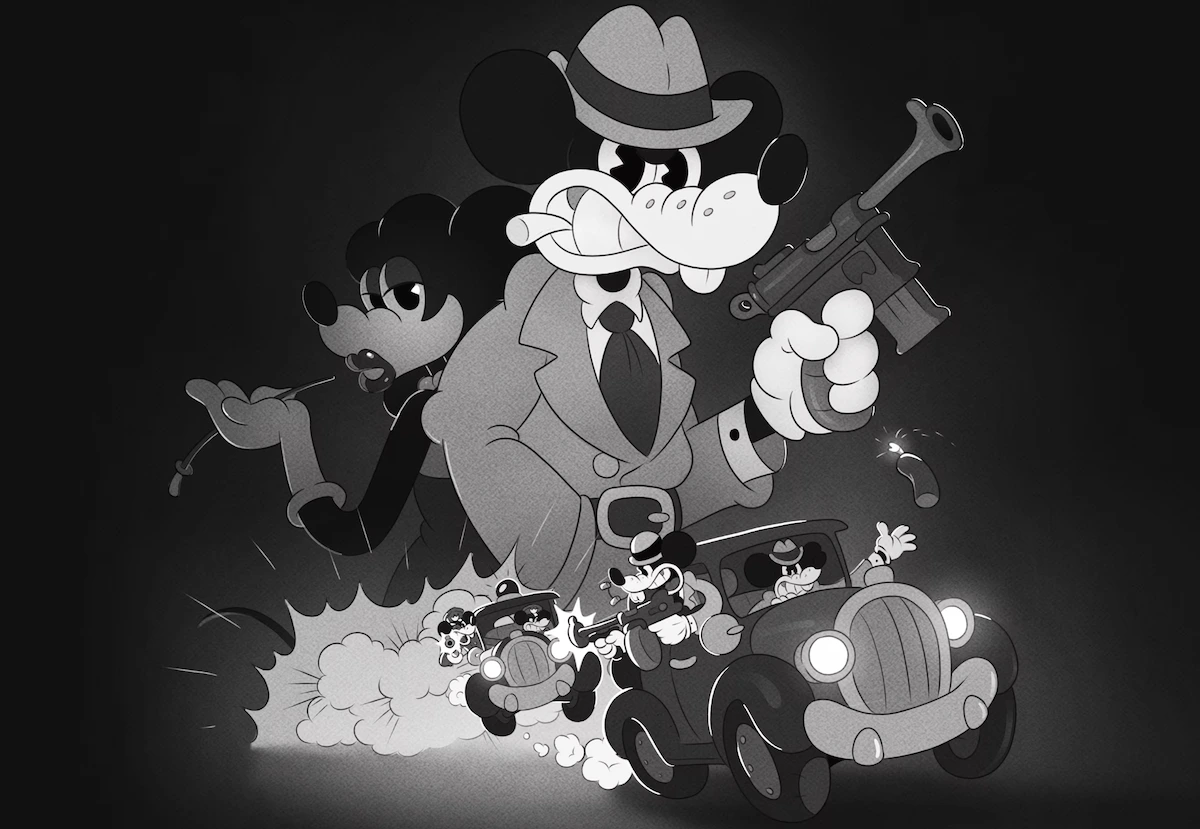
The standout feature of Mouse: P.I. For Hire is undoubtedly its visual presentation. Inspired by 1930s animation, the game uses hand-drawn “rubber hose” style characters and environments that evoke early cartoon classics.
The attention to detail is impressive:
- Enemies morph into skeletons or dissolve into cartoon dust when defeated
- Weapons are animated with exaggerated, elastic motion
- NPCs populate the world with expressive, hand-crafted designs
Players can also customize the visual experience. Options allow switching between crisp black-and-white visuals and grainy film-like filters that replicate early cinema. Audio settings follow a similar approach, offering modern clarity or vintage radio-style sound.
Combined with a jazz and swing-inspired soundtrack performed by a live band, the presentation creates a strong and memorable atmosphere. For many players, this alone justifies trying the game.
4. Gameplay Mechanics: Classic but Limited
At its core, the game plays like a traditional “boomer shooter.” Movement is fast and fluid, emphasizing constant motion rather than precision aiming.
Key gameplay features include:
- Weapon switching via a classic wheel system
- No aim-down-sights mechanics
- Melee attacks and mobility options like dash and double jump
- Upgradeable weapons with alternate firing modes
While the shooting feels responsive, it lacks impact in some areas. Hit feedback is relatively weak, meaning attacks don’t always feel as satisfying as they should. The weapons are creative but could benefit from more variety and depth.
Additionally, certain design choices—such as manually equipping throwables—can feel outdated rather than nostalgic.
5. Level Design and Exploration
The game includes a top-down overworld map where players drive between locations, adding a layer of exploration beyond linear missions. Individual levels often feature:
- Multiple paths
- Hidden collectibles
- Resource management (ammo, health, currency)
However, while some areas are visually striking, others feel repetitive. Generic corridors and less distinctive environments occasionally break immersion, especially compared to the otherwise strong art direction.
Puzzle elements are present but inconsistent. Some provide satisfying challenges, while others may slow down pacing.
6. Difficulty and Combat Flow
The game offers three difficulty modes—easy, normal, and hard—but even the standard experience becomes challenging over time. Enemy encounters grow more intense, and boss fights require constant movement and awareness.
Combat arenas are often compact, forcing players to:
- Strafe and dodge frequently
- Manage resources carefully
- Adapt to enemy patterns
Interestingly, despite controller support, the gameplay feels more suited to keyboard and mouse due to its speed and precision requirements.
7. Story and Narrative Execution
Despite being marketed partly as a story-driven experience, the narrative is one of the weaker aspects of the game.
The noir-inspired plot follows familiar detective tropes, but:
- Dialogue often lacks impact or humor
- Story pacing feels slow compared to gameplay
- Mystery elements fail to fully engage
There is a significant amount of dialogue presented through static character interactions with text boxes. While voice acting—particularly the performance of the main character—is solid, it cannot fully compensate for the lack of compelling writing.
As a result, players may find themselves more interested in returning to action sequences than progressing the story.
8. Strengths and Weaknesses
Strengths
- Unique and visually stunning 1930s cartoon style
- Strong audio design with authentic jazz soundtrack
- Fast-paced, accessible FPS gameplay
- Creative weapon upgrade system
Weaknesses
- Weak narrative and forgettable dialogue
- Inconsistent level design
- Limited combat depth and feedback
- Some outdated gameplay mechanics
Is It Worth Playing?
Mouse: P.I. For Hire is a game defined by contrast. On one hand, it delivers an exceptionally creative visual experience rarely seen in modern games. On the other, its gameplay and narrative fall short of fully matching that ambition.
This is not a must-play for everyone. However, it becomes much more appealing if you:
- Enjoy retro-style first-person shooters
- Appreciate experimental art direction
- Like noir-inspired settings and jazz soundtracks
For those players, the game offers a solid, if imperfect, experience. For others, it may feel like style outweighs substance.
“`html “`
Mouse: P.I. For Hire succeeds in proving that bold artistic vision can still capture attention in a crowded market. While it doesn’t fully realize its potential, it lays a strong foundation that could be expanded in future iterations.
If the developers refine the gameplay systems and strengthen the narrative, a sequel could turn this promising concept into something truly exceptional. For now, it remains a visually impressive but uneven experience, worth checking out, but not essential.