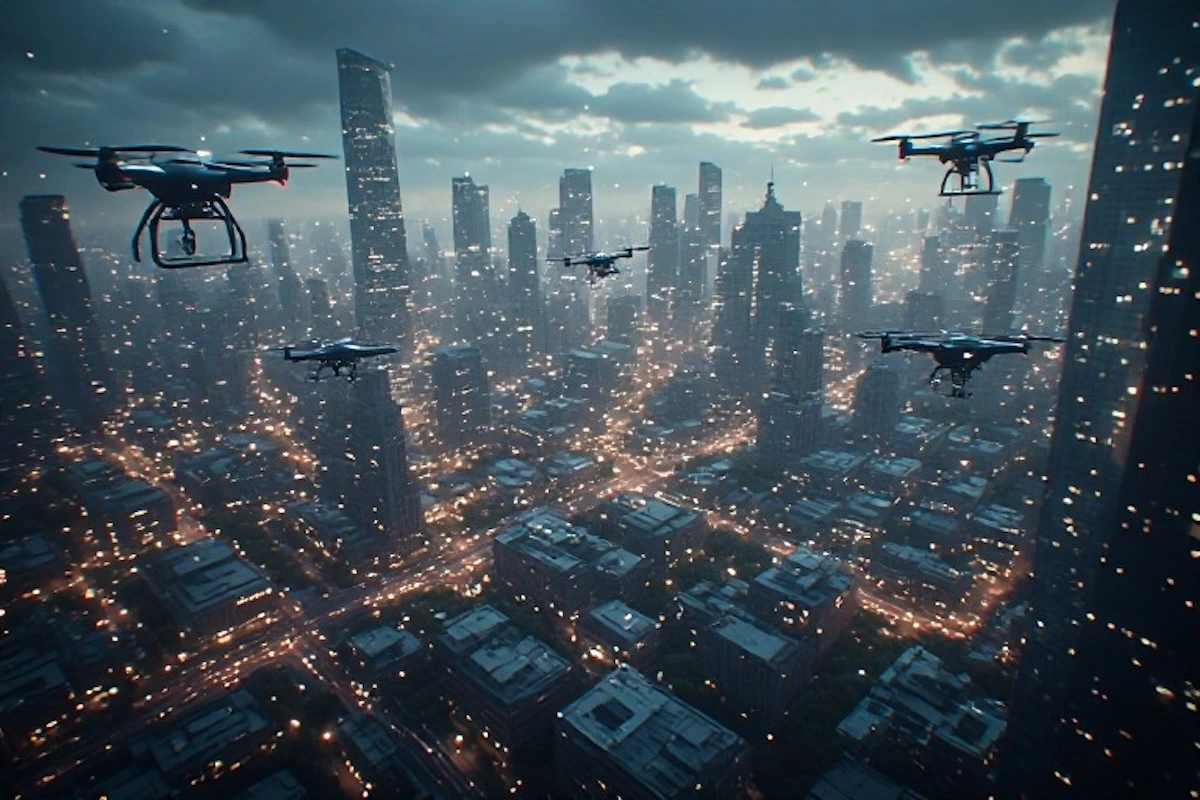
As the United States marks its 250th anniversary, a convergence of technologies is emerging that experts believe will reshape how people move, build, heal, and think over the next quarter century. Electric air mobility, AI systems capable of modelling the physical world, and personalised biotechnology are no longer science fiction — they are engineering projects in active development. The question is no longer whether these shifts will happen, but how quickly and on what terms.
Contents
- The four innovation pillars shaping the next 25 years
- eVTOL: the flying taxi that could redraw the American city
- Physical AI: the missing ingredient in the engineering revolution
- Biotech and personalised medicine: the underestimated frontier
- AI and human agency: what we risk if we get this wrong
- America’s innovation edge — and what threatens it
- What the next 25 years actually look like: a 2050 scenario
The four innovation pillars shaping the next 25 years
Technology forecasting is a notoriously humbling exercise. Five years ago, the most credible AI researchers placed many of today’s AI capabilities several decades away. The pace of change has made those estimates look quaint. With that context in mind, the technologies most likely to define the coming 25 years share a common trait: they are not speculative concepts but active engineering disciplines where significant commercial and regulatory progress is already visible.
eVTOL Air Mobility
Electric vertical takeoff and landing aircraft that operate quietly, cleanly, and at costs far below conventional helicopters. Already in FAA certification and carrying passengers in Dubai in 2026.
Active deploymentPhysical AI
AI models trained to understand and predict the behaviour of matter, energy, and dynamics — heat transfer, fluid flow, structural failure. Enabling engineering simulation thousands of times faster than today.
Early stage / high growthBiotech & Personalised Medicine
AI-accelerated drug discovery, protein modelling, and treatments tailored to an individual’s biology. Regarded by leading thinkers as one of the most underestimated technology frontiers of the decade.
UnderestimatedAI and Human Agency
The societal question that cuts across all the others: how do individuals, institutions, and policymakers navigate a world where AI can answer almost any question — without delegating the capacity to think?
Critical policy gapeVTOL: the flying taxi that could redraw the American city
For decades, the promise of personal air mobility existed mainly in concept art and optimistic conference presentations. That is changing rapidly. Electric vertical takeoff and landing aircraft — eVTOL — represent a category of vehicles that take off and land like helicopters but operate more like fixed-wing aircraft once airborne, transitioning to winged flight for dramatically greater energy efficiency. They run on electric motors, produce a fraction of the noise of conventional rotorcraft, and are being designed from the ground up with urban integration in mind.
Joby Aviation, one of the sector’s most advanced developers, reached Stage 4 of the FAA’s five-stage certification programme — one of the most advanced positions among eVTOL developers globally — and began flight testing its first production-conforming aircraft at its Marina, California facility in 2026. The aircraft carries one pilot and four passengers and is being tested across multiple US states ahead of full commercial certification, expected around 2027.
Joby Aviation — key figures at a glance
FAA certification stage (Joby)
Stage 4 of 5
Test miles completed (Joby, 2025)
50,000+
Passenger capacity
4 + pilot
Production target (2027)
4/month
First commercial service
Dubai 2026
US operations target
2026–2027
The urban implications of this technology extend well beyond convenience. America’s housing affordability crisis is, in significant part, a geography problem: the land where people most want to live is constrained by proximity to employment, and commute time functions as an invisible wall around city centres. A vehicle capable of covering a journey that currently takes ninety minutes in under fifteen minutes does not merely save time — it fundamentally expands the definition of where it is practical to live. The economic logic mirrors that of the interstate highway system, which unlocked millions of acres of land for development and community growth when introduced in the 1950s.
The infrastructure parallel: Just as the interstate highway system required federal investment and planning to unlock its transformative potential, eVTOL networks will require a parallel commitment to vertiport infrastructure — the physical landing, charging, and passenger facilities that make the service work. The FAA’s eVTOL Integration Pilot Programme is already enabling pre-certification operations in states including Texas, Florida, and New York, with public-private partnerships forming to fund the physical network these aircraft will depend on.
The near-term vehicle will be piloted. Autonomy will come later, following the same regulatory maturation path that is currently unfolding in the autonomous vehicle space. Initially, that means a skilled human in the cockpit — which contributes significantly to safety margins and helps build public trust during the early years of operation.
Physical AI: the missing ingredient in the engineering revolution
The AI that most people interact with daily — conversational assistants, image generators, code tools — is built on language. It has been trained to understand and produce text, and it is extraordinarily good at that. But it carries a fundamental limitation: it has no inherent understanding of how the physical world behaves. It cannot reliably predict how a material will respond to heat, how a fluid will flow around an obstacle, or at what stress level a structure will fail. These are questions governed by the laws of physics — and they are precisely the questions that underpin the entire hardware economy.
Approximately $4 trillion worth of hardware products were manufactured globally last year. For every one of those products to exist, an engineer had to know how it would behave if dropped, if it overheated, if it was subjected to pressure. Physical AI aims to answer those questions thousands of times faster than current methods allow.
The engineering simulation software market is already valued at over $15 billion in 2026 and is projected to double by 2031, driven by AI tools that drastically compress design cycle times. PhysicsX, a leading company in this space, recently closed a $300 million Series C funding round at a valuation of approximately $2.4 billion, with backing from Temasek, NVIDIA, Siemens, and General Catalyst. The company is building what it describes as Large Physics Models — pre-trained AI systems designed to understand physical behaviour broadly across many industries, in the same way that large language models understand text.
The practical consequences are significant. Traditional engineering simulations for complex components like aircraft engines or semiconductor chips can take hours or days per design iteration, severely limiting how many design options any team can explore within a given project timeline. AI-accelerated physical simulation compresses that to minutes — or in some cases, seconds. The knock-on effect is a dramatic democratisation of who can do serious engineering work. Capabilities that currently require specialist teams, expensive supercomputing time, and months of iteration become accessible to smaller organisations with fewer resources.
The AlphaFold parallel: In 2020, DeepMind’s AlphaFold solved one of biology’s most challenging long-standing problems — predicting how proteins fold — with AI. It became a landmark moment for life sciences, unlocking research that had been stalled for decades. Physical AI represents a comparable opportunity for the material and engineering sciences: a moment when the tools of simulation and design catch up with the ambition of engineering.
Biotech and personalised medicine: the underestimated frontier
Ask most people to name the most consequential technology trend of the next decade and they will say artificial intelligence. Ask them about biotechnology and personalised medicine and you are more likely to draw a blank or a vague reference to gene editing. Yet among the thinkers most closely engaged with the intersection of AI and science, there is a consistent view that the fusion of these two fields represents the most underappreciated opportunity — and one of the most personally meaningful for the vast majority of people who will experience it.
The logic is straightforward: AI’s ability to model complex systems at speed is exactly what has historically made drug discovery so slow and expensive. A single successful drug can take a decade and more than a billion dollars to reach patients, with most candidates failing at some point in that journey. AI tools applied to molecular biology, protein behaviour, genetic data, and clinical outcomes can compress parts of that cycle dramatically — not by replacing the biology, but by making the hypothesis-testing process vastly more efficient.
The argument for prioritising biotech: Every other technology on this list depends on people being alive and healthy enough to use it. AI, eVTOL, and physical AI create extraordinary economic and practical value — but personalised medicine addresses something more foundational. A treatment matched to an individual’s specific biology, discovered and validated in a fraction of the time it takes today, has implications that reach every other dimension of human life.
AI and human agency: what we risk if we get this wrong
Running beneath every conversation about the next 25 years of technology is a question that rarely makes it onto the main stage: what happens to human thinking in a world where AI can answer almost anything, instantly, and increasingly well?
The concern is not that AI will make people intellectually lazy in some abstract sense. The concern is more specific and more structural. When people — particularly young people still in the process of forming habits of thought — go directly to AI for answers to questions they have not yet attempted to reason through themselves, they are not merely outsourcing a task. They are outsourcing the cognitive process that builds reasoning capability in the first place. The act of struggling with a problem, making an attempt, being wrong, and refining the answer is not an inefficiency to be eliminated. It is how learning works.
The “mast principle”: One framework for managing AI dependence draws on Homer’s Odyssey, where Odysseus tied himself to the ship’s mast so he could hear the sirens’ song without being destroyed by it. Applied to AI: use the technology, hear what it offers, but build constraints into the relationship. One concrete application — try to form your own answer to a question first, then bring that answer to AI and ask what you are missing or could do better. This preserves the cognitive work while still benefiting from AI’s speed and breadth.
America’s innovation edge — and what threatens it
The United States has been the dominant source of foundational technology innovation for the better part of a century. That position is built on a small number of structural foundations: a world-class research university system that attracts global talent, an immigration framework that has historically channelled exceptional minds from around the world toward American institutions and companies, and a culture of risk-taking and investment that tolerates failure as a necessary cost of breakthrough.
Each of these foundations is currently under some degree of pressure. Restrictions on student and skilled-worker immigration reduce the flow of international talent into research and commercial AI. Funding cuts to basic science research reduce the supply of early-stage discoveries that eventually become commercial technologies. These are the upstream inputs to the innovation economy — and their deterioration, if unchecked, will show up in reduced output downstream, years later, when it is harder to course-correct.
The diffusion gap: While the United States leads in foundational research and invention, other economies — particularly China — have developed significant strengths in the rapid deployment and scaling of technology that originates anywhere in the world. Diffusion: making technology affordable, accessible, and widely distributed, is a distinct capability from invention, and one that determines who actually benefits from innovation at a population level. Closing the gap between invention and diffusion within the US is one of the more consequential policy choices of the coming decade.
What the next 25 years actually look like: a 2050 scenario
If the technologies described in this article develop on their current trajectories — and if the policy environment supports rather than obstructs that development — the lived experience of daily life in 2050 looks meaningfully different from today.
By ~2030
Air taxis operational
eVTOL air taxis carrying passengers commercially in major US cities, initially piloted, with vertiport infrastructure embedded in urban centres and transport hubs.
By ~2032
Engineering democratised
Physical AI simulation tools available to small and mid-size engineering firms, compressing product development cycles from months to days across aerospace, energy, and manufacturing.
By ~2035
Drug discovery transformed
AI-accelerated biotech platforms reducing the time from target identification to clinical candidate from years to months, producing cheaper and more personalised treatments across multiple disease categories.
By ~2040
Knowledge work redefined
AI handles large portions of routine knowledge tasks; human value increasingly concentrated in judgment, creativity, relationships, and the ability to ask better questions — not just find faster answers.
By ~2050
Physical AI as infrastructure
AI with physics constraints running quietly inside power grids, factories, spacecraft, and drug development platforms — invisible, essential, and generating value across every sector of the economy.
Ongoing
Human agency the open question
The degree to which individuals, institutions, and societies maintain meaningful cognitive and economic agency in an AI-saturated world remains the defining challenge — and the defining choice — of the era.
The most striking feature of this moment is not any individual technology. It is the convergence. Physical AI accelerates the development of eVTOL aircraft. eVTOL networks reshape the value of urban geography in ways that ease housing pressure. Personalised medicine extends healthy productive years. Better AI tools democratise access to capabilities that were previously limited to elite institutions. And all of it depends on whether societies make the policy, educational, and infrastructural choices that allow these technologies to flourish — and distribute their benefits broadly enough to generate stability rather than disruption.
As one framing has it: the question is not whether technology will change the world. It already is. The question is whether the people and institutions shaping it will move fast enough, and thoughtfully enough, to catch up.
Invest in vertiport infrastructure now
The physical backbone of eVTOL networks requires federal-private partnerships beginning today for the technology to deliver its 2030s potential.
Build physical AI into engineering education
The next generation of engineers needs fluency in AI-augmented simulation tools, not just traditional numerical methods.
Protect the innovation pipeline
Research funding, university excellence, and talent immigration are upstream inputs to downstream commercial innovation.
Prepare policy for knowledge-work disruption
The social safety net was not built for a world where white-collar employment changes at the pace AI is beginning to enable.
Teach people to use AI as a tool, not a replacement
The habit of attempting problems independently before consulting AI is one of the simplest and most powerful investments individuals can make in their own long-term capability.