
In a strategic step toward safeguarding its financial stability and improving long-term debt servicing, Montenegro has extended its hedging agreement on a Chinese infrastructure loan through July 2028. The move is designed to shield the country’s budget from foreign exchange fluctuations tied to a $754 million loan from China’s Export-Import Bank (Exim Bank), originally contracted for the construction of the Bar–Boljare motorway.
Long-Term Vision for Financial Risk Management
The hedging agreement, initially signed in January 2024, was established as a cross-currency swap with four leading European and U.S. financial institutions. It converts the U.S. dollar-denominated loan into euros at an average exchange rate of 1.087 EUR/USD. This ensures greater predictability and resilience in Montenegro’s fiscal planning by reducing exposure to the volatile currency markets.
Given recent projections indicating a potential mid-term strengthening of the euro against the U.S. dollar, the Ministry of Finance opted to extend the current structure of the hedging arrangement by an additional 2.5 years, now covering six more loan installments until mid-2028.
Crucially, this extension includes a built-in flexibility clause that allows the government to revise the hedging terms if further protection is needed, enhancing Montenegro’s adaptive capacity in the face of evolving economic conditions.
Significant Cost Savings for the State Budget
The Ministry of Finance has reported that the hedging strategy has already saved the Montenegrin budget approximately €12 million ($13.6 million) since its implementation in early 2024. The fixed interest rate of 1.46% under the hedging deal remains below the original 2% rate, as stipulated in the Exim Bank contract, generating further cost efficiency over the life of the loan, which matures in 2035.
This financial optimization reinforces Montenegro’s ongoing efforts to manage its debt burden responsibly while maintaining access to international capital markets and fostering investor confidence.
The Bar–Boljare Motorway: Strategic Infrastructure with Regional Impact
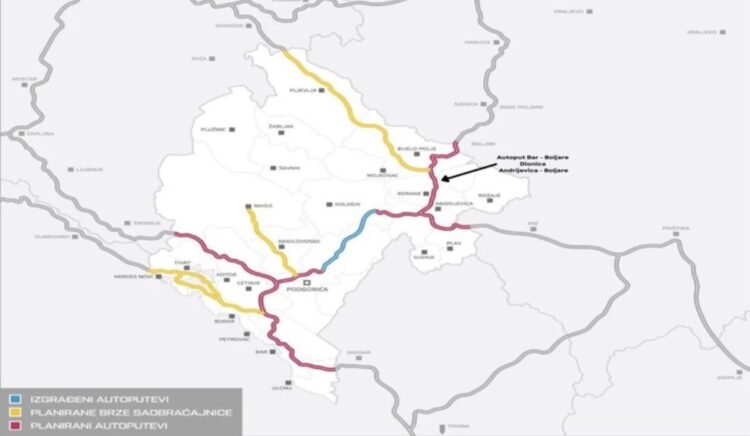
Originally financed through a $944 million loan agreement in 2014, the Bar–Boljare motorway is Montenegro’s most ambitious infrastructure project to date. The motorway aims to connect the Adriatic port of Bar with the Serbian border in the north, forming part of European Transport Corridor XI — a transnational route linking Bari (Italy), Bar (Montenegro), Belgrade (Serbia), and Bucharest (Romania).
Construction of the first 41-kilometer section between Smokovac and Mateševo began in May 2015 and was completed in July 2022 by China Road and Bridge Corporation (CRBC). Three additional segments — Mateševo-Andrijevica, Andrijevica-Boljare, and Podgorica-Đurmani — remain under development as Montenegro continues to prioritize this critical artery for trade, tourism, and regional integration.
Aligning with Eurozone Goals and Sustainable Development
Montenegro’s decision to hedge against currency risks is not only a matter of prudent fiscal policy but also aligns with its broader goal of eventual euro adoption. Though not a member of the Eurozone, Montenegro uses the euro unilaterally. By minimizing exposure to currency volatility, the country strengthens its monetary coherence with the euro area, enhancing the credibility of its economic reforms.
Furthermore, the Bar–Boljare motorway supports Montenegro’s commitments to sustainable development and regional cooperation, by improving cross-border connectivity and reducing logistical bottlenecks that hamper economic growth.
Montenegro’s extension of the hedging agreement through 2028 reflects a proactive and forward-thinking approach to public debt management. With measurable budgetary savings, improved fiscal resilience, and continued infrastructure development, the country is not only stabilizing its present but also strategically paving the road toward long-term economic integration and prosperity.