If the last time you really paid attention to airport security or airline rules was a couple of years ago, several things have quietly changed under you in 2026 — and at least one widely repeated claim about what changed is wrong. Between a new REAL ID noncompliance fee, a genuine but limited liquid-screening upgrade, tighter power bank rules that took effect airline by airline, Southwest’s end of open seating, and a European entry system that still hasn’t actually launched despite plenty of headlines claiming otherwise, it’s a lot to track. Here’s what’s actually confirmed, what’s still rolling out, and what’s still just a rumor.
Key Takeaways
- Since February 1, 2026, travelers who show up at security with a non-REAL-ID-compliant license face a $45 fee for a temporary 10-day identity-verification workaround — carrying a passport or compliant license avoids it entirely.
- CT scanners now let travelers leave laptops and small liquids inside their bag at roughly two dozen major US airports — but contrary to a claim circulating online, the 3.4-ounce liquid size limit has not been eliminated anywhere in the US.
- As of May 1, 2026, American, Delta, and Southwest all require portable chargers to stay with the passenger — not in the overhead bin — and cap most passengers at one or two chargers of 100 Wh or less.
- Southwest Airlines ended 54 years of open seating on January 27, 2026, moving to assigned, numbered seats — one of two major policy changes the airline made this year.
- Europe’s ETIAS travel authorization, often reported as already required, is still not live as of this writing — it’s expected to launch sometime in Q4 2026 with a six-month grace period, at a confirmed €20 fee.
REAL ID: The Grace Period Is Over, and Now There’s a Fee
REAL ID enforcement began in earnest in May 2025, but 2026 added a concrete financial consequence for showing up without one. As of February 1, 2026, a traveler who presents a non-compliant driver’s license at a TSA checkpoint can still fly, but only after paying a $45 fee for additional identity verification — and that workaround is valid for just 10 days before it has to be repeated. A valid passport or a REAL ID-compliant license avoids the fee entirely, which makes checking your license’s compliance status before your next trip a genuinely free way to save $45. Minors traveling with a compliant adult remain exempt; a solo teenager still needs valid, compliant identification.
For the full rundown of what counts as compliant, how to tell if your existing license already qualifies, and what to do if it doesn’t, see our earlier deep dive: REAL ID Enforcement in 2026: What Actually Changed and What to Do If You Don’t Have One.
The Liquid Rule Myth: What CT Scanners Actually Changed
This is the one worth correcting directly, because a version of it keeps circulating that isn’t accurate. TSA has been installing advanced CT (computed tomography) scanners — the same 3D-imaging technology some UK airports have used to drop liquid restrictions entirely — at major US airports for several years, and the rollout has genuinely expanded through 2026. Airports including Atlanta, Boston Logan, Dallas/Fort Worth, Denver, Las Vegas, Los Angeles, Miami, Seattle-Tacoma, San Francisco, and Tampa now have CT lanes, alongside a longer list of airports in TSA’s innovation testing network.
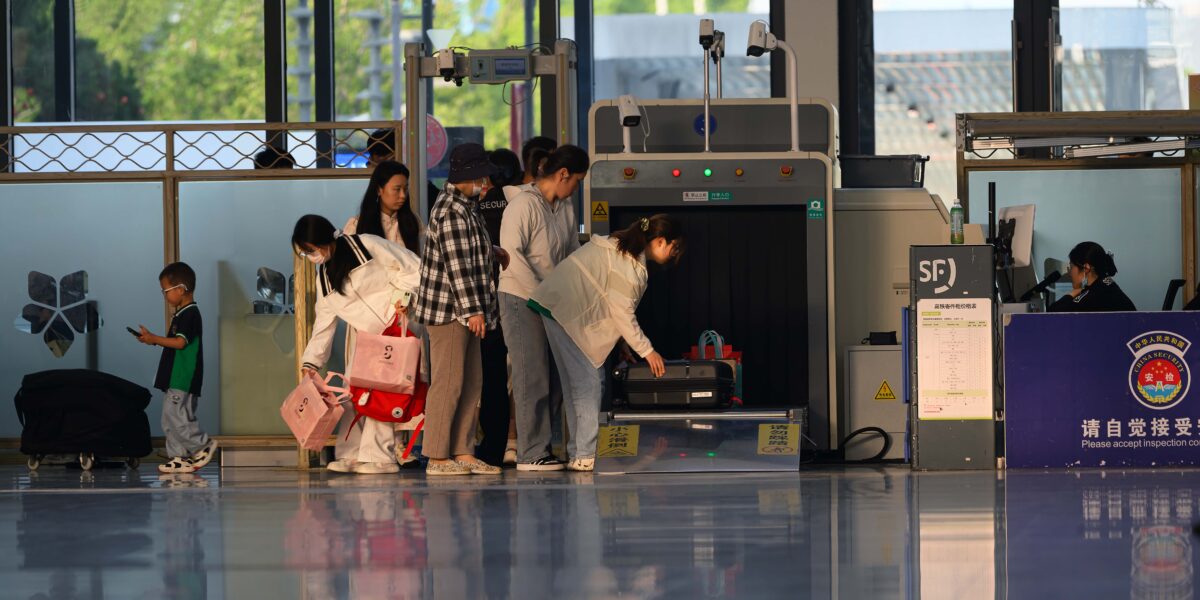
What that upgrade actually does: at a CT-equipped lane, you can typically leave your laptop and your travel-size liquids inside your carry-on bag during screening, since the scanner can see through the bag clearly enough not to need them separated out. What it does not do, despite claims that have spread online about “11 exempted items” and liquids of any size being allowed through: change the 3.4-ounce (100 ml) size limit on ordinary liquids, gels, and aerosols. TSA’s own guidance is explicit that this limit still applies nationwide, CT scanner or not — a full-size bottle of shampoo or a large water bottle still won’t clear security at any US airport in 2026, unlike at London City Airport and a handful of other UK airports that have actually eliminated the limit using the same underlying technology.
There’s also a practical wrinkle worth knowing: CT deployment is lane-by-lane, not airport-wide. Two adjacent lanes at the same airport can have different equipment, meaning the rules on what needs to come out of your bag can vary from one checkpoint line to the next at the same terminal. When in doubt, watch what the line in front of you is doing, or ask a TSA officer directly, rather than assuming the whole airport works the same way.
Power Banks and Lithium Batteries: The Rule That Actually Tightened
While the liquid rule mostly didn’t change, portable charger rules genuinely did, and this is the one most frequent flyers are likely to get caught out by if they haven’t flown recently. The FAA baseline hasn’t moved: batteries up to 100 watt-hours (Wh) travel without airline approval, batteries between 101–160 Wh need approval, and anything over 160 Wh is prohibited outright. Spare lithium-ion batteries and portable chargers have always been required to travel in carry-on baggage, never checked.
What’s new for 2026 is stricter in-flight handling. Effective May 1, 2026, American Airlines and Delta both cap passengers at two portable chargers, each 100 Wh or under, and require that chargers stay with the passenger — visible and within reach — rather than being stowed in the overhead bin or used to charge a device tucked away out of sight. Southwest’s version of the same rule is even tighter: one charger per passenger, under 100 Wh, also required to stay with the passenger rather than in the bin. Airlines are citing the same underlying concern driving similar moves worldwide: a lithium battery fire is far easier for a crew to catch early if the device is visible and accessible, rather than smoldering inside a bag in an overhead bin.
| Airline | Charger Limit | Must Stay With Passenger? |
|---|---|---|
| American Airlines | 2 chargers, ≤100 Wh each | Yes — not in overhead bin |
| Delta Air Lines | 2 chargers, ≤100 Wh each | Yes — not in overhead bin |
| Southwest Airlines | 1 charger, <100 Wh | Yes — not in overhead bin |
The practical takeaway: if you’re used to charging your phone from a power bank tucked in the seatback pocket or overhead bin during a flight, that habit is now against policy on several major US carriers. Keep it in your lap or your under-seat bag instead, and check your specific airline’s current policy before a long flight if you’re relying on a power bank to get through it.
Southwest Ends Open Seating After More Than 50 Years
Southwest Airlines’ open-seating, first-come-first-served boarding — a defining feature of the airline since it began flying in 1971 — officially ended on January 27, 2026. Passengers now receive an assigned, numbered seat at booking, and boarding groups are tied to that seat assignment rather than to how early a passenger checked in. It’s a genuine culture shift for an airline that spent decades marketing open seating as a customer-friendly point of difference, and it brings Southwest’s boarding process in line with every other major US carrier.
Southwest also updated its policy for passengers who need extra seating space: a second seat now must be purchased at full price, with a refund issued only if the flight ultimately departs with empty seats available — a change from the airline’s previous, more accommodating approach.
Loyalty Programs Keep Getting Less Generous for Basic Economy
Frequent flyer earning has continued its multi-year shift away from distance-based miles and toward fare-based earning, and 2026 brought that shift further into basic economy specifically. Delta and American now calculate loyalty earnings based on the fare paid rather than distance flown, and basic economy tickets on both carriers earn no loyalty credit at all. United’s basic economy fares earn partial credit rather than none. Southwest doesn’t use fare-class mileage multipliers in the first place, so its program is unaffected by this particular shift. The practical upshot for anyone who books the cheapest available fare as a habit: check what that fare actually earns before assuming a flight is contributing to elite status or a future free trip the way it might have a few years ago.
Europe’s ETIAS: Still Not Live, Despite What You May Have Read
This is the second correction worth making clearly. Plenty of articles this year have described the European Travel Information and Authorisation System (ETIAS) as already required for US, UK, Canadian, and Australian travelers visiting Europe. As of this writing, that’s not accurate — ETIAS has not launched yet. The European Commission has confirmed a Q4 2026 launch window (October through December) without naming an exact date, and it has committed to giving at least six months’ advance public notice before the system actually goes live.
What is confirmed: the fee will be €20 per person (travelers under 18 or over 70 are fee-exempt but still need to apply), the authorization will be valid for three years or until the traveler’s passport expires, whichever comes first, and it will apply to visa-exempt travelers from roughly 60 countries visiting any of 30 European countries — the 29 Schengen states plus Cyprus. Once ETIAS does launch, a six-month transitional period is expected to follow, pushing full mandatory enforcement out to around April 2027. Travelers with European trips planned for the rest of 2026 don’t need an ETIAS application yet — but it’s worth checking the official EU ETIAS information page close to departure, since the launch could land inside that window depending on timing.
Separately, and moving on its own slower timeline, the EU’s Entry/Exit System (EES) — which replaces manual passport stamping with biometric facial recognition and fingerprint scanning at the border — is still in gradual rollout and requires no advance action from travelers; it’s handled entirely at the border checkpoint itself.
A Few Smaller Changes Worth Knowing
- Shoes mostly stay on. Since 2025, most travelers no longer need to remove their shoes at standard TSA checkpoints, though additional screening can still require it in individual cases.
- A limited “guest pass” pilot is underway. A small number of airports — San Diego, Seattle, Orlando, Philadelphia, and San Francisco — are testing a program that lets a non-ticketed person accompany a traveler through security to the gate, with advance application and a digital pass required.
How to Actually Prepare for These Changes
- Confirm your license’s REAL ID status before your next trip, not at the checkpoint — it’s a free five-minute check that avoids a $45 fee.
- Don’t assume a CT-equipped lane means unlimited liquids. The 3.4-ounce limit still applies everywhere in the US; the scanner just may let you leave items packed rather than pulling them out.
- Move your power bank out of the overhead bin. Keep it with you in the cabin, check your specific airline’s current charger count and wattage limit before a long flight, and don’t charge a device you can’t see or reach.
- Check your Southwest seat assignment ahead of time rather than assuming you can pick a seat at the gate the way open seating used to allow.
- Hold off on an ETIAS application until the European Commission’s official launch announcement — applying before the system is live isn’t possible, and the requirement isn’t enforced yet regardless of what you may have read elsewhere.
If your travel plans this year also touch a possible federal funding lapse, our companion piece on what December’s government shutdown deadline could mean for holiday travel covers that separate risk in detail, and our guide to this year’s clock change on November 1 is worth a quick check if any of your trips span that date.
FAQ
Has the 3.4-ounce liquid rule actually been eliminated in the US?
No. Despite claims circulating online about exempted items and CT scanners removing the size limit, TSA’s 3.4-ounce (100 ml) restriction on ordinary liquids, gels, and aerosols remains in effect at every US airport as of this writing. CT scanners at some airports may let you leave liquids inside your bag during screening, but the size limit itself hasn’t changed.
Is ETIAS required to travel to Europe right now?
No. ETIAS has not launched yet. It’s expected to go live sometime in Q4 2026, with a six-month grace period likely extending mandatory enforcement to around April 2027. Check the official EU ETIAS page before booking to confirm current status.
Can I put my portable charger in the overhead bin during a flight?
On American, Delta, and Southwest, no — as of May 1, 2026, portable chargers must stay with the passenger, not in the overhead bin, and each airline caps both the number of chargers and their watt-hour rating.
What happens if I show up to security without a REAL ID-compliant license?
Since February 1, 2026, you can still fly after paying a $45 fee for additional identity verification, valid for 10 days. A passport or a compliant license avoids the fee entirely.
Does Southwest still have open seating?
No. Southwest ended open seating on January 27, 2026, after more than 50 years, and now assigns numbered seats at booking like other major US airlines.
The Bottom Line
Most of what’s genuinely changed for air travelers in 2026 is incremental rather than dramatic — a fee here, a tightened battery rule there, an airline finally assigning seats. The bigger risk this year isn’t missing a real change; it’s acting on one of the two rumors that turned out to be wrong, whether that’s packing a full-size shampoo bottle because a CT scanner supposedly makes it fine, or skipping an ETIAS application deadline that hasn’t actually arrived yet. A five-minute check of your airline’s current policy and the official TSA and EU sites before you fly is still the most reliable way to avoid a surprise at the gate.
Airline and government travel policies change frequently and can vary by airport, airline, and individual circumstance. This article reflects publicly available information as of publication; confirm current requirements with TSA, your airline, and the official EU ETIAS website before traveling.