A Market Nobody Saw Coming
In the first half of 2026, Midea’s air-conditioner sales in Germany, France, Spain and the UK rose more than 70% year-on-year. Gree’s terminal sales in France climbed 50%. TCL told the Global Times its French AC sales jumped over 300%. None of these are European companies, and until a few summers ago, few Europeans could have named a Chinese appliance brand at all.
That’s changing fast, and it’s changing because of heat. Europe just recorded its hottest June on record, according to Copernicus, followed by a heat dome that pushed Spain’s Fabra Observatory in Barcelona to 40.5°C on 8 July — the highest reading there in over a century of data. EuroMOMO’s mortality-monitoring network logged roughly 14,260 excess deaths in the single week ending 28 June, with more recent estimates from Indiana University researchers running as high as 20,390 for the June heatwaves overall. Air conditioning has gone, in the space of a few summers, from a discretionary comfort item to something closer to a health necessity in parts of Western Europe.
The thesis of this piece is simple: Europe’s AC boom is a story about climate, but the reason it’s Chinese brands filling that demand is a story about industrial design, regulation, and a European manufacturing base that wasn’t built for a market this size. Below, we walk through the ownership gap Europe started from, why Chinese manufacturers moved faster than their European rivals, what the trade fallout looks like, and where the analysis runs into real limitations.
Europe’s Unusual Cooling Gap
Air-conditioner “penetration rate” — the share of households that own at least one unit — is the key metric here, and Europe’s has historically been an outlier among wealthy regions. Roughly 20% of European households have air conditioning, compared with about 90% in the United States and even higher rates across much of hot-climate Asia. That average hides sharp national variation: Italy sits around 56% after a rapid buildout since the 2000s, France is closer to 28%, Germany lags near 18%, and the UK has roughly four million AC-equipped homes — about twice as many as three years ago, but still a small minority of the housing stock.
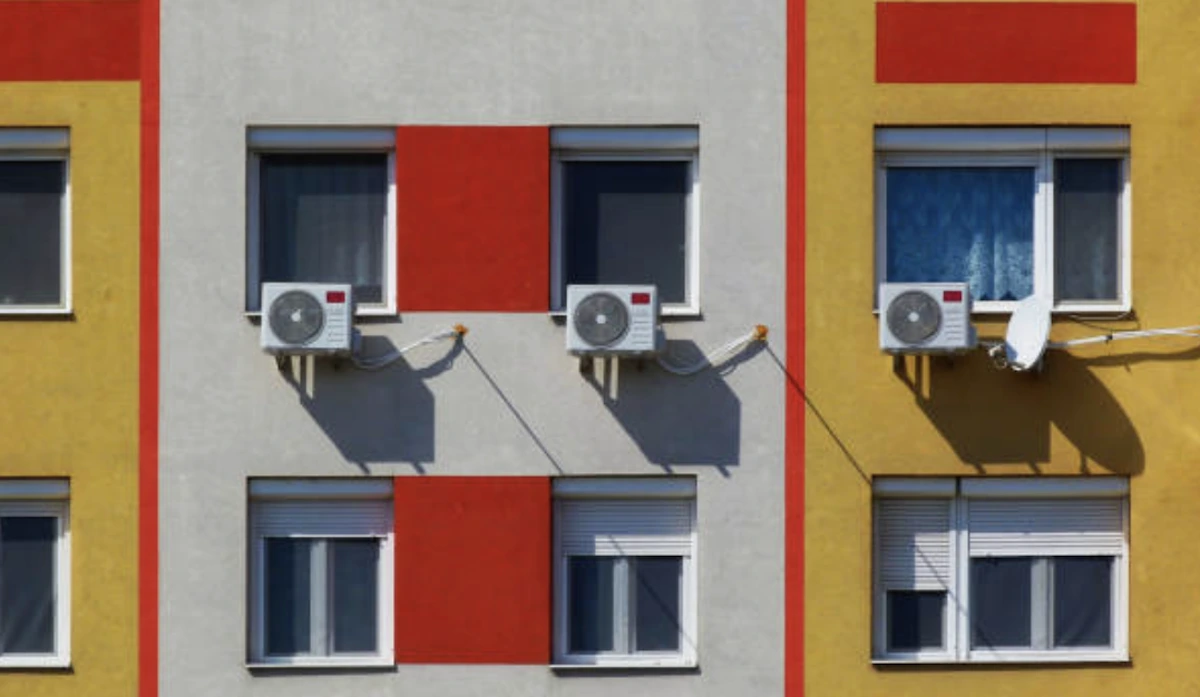
The historical reason is structural, not cultural. Northern and Central European building codes, mild historical summers, and high electricity prices meant AC was never designed into the housing stock the way heating was. Retrofitting is expensive: split-system units typically require an outdoor condenser, drilled facades, and a licensed installer, and in cities like Paris, heritage rules and co-op building regulations restrict exactly that kind of exterior modification. Europe’s cooling gap, in other words, isn’t a demand gap — it’s a supply-and-installation gap that got exposed the moment demand spiked.
That’s the opening Chinese manufacturers walked through.
The Numbers Behind the Boom
Sales Growth in 2026
| Company | Market / Metric | Change | Period |
|---|---|---|---|
| Midea | Germany, France, Spain, UK sales | +70% YoY | H1 2026 |
| Gree | France terminal sales | +50% YoY | H1 2026 |
| TCL | France AC sales | +300% YoY | H1 2026 |
| Midea PortaSplit | Units shipped | 200,000+ | 2026, doubling yearly since launch |
| China (industry-wide) | AC exports to EU | $3.76B, +43.2% YoY | H1 2026 |
Methodology note: figures above are synthesized from company disclosures reported by the BBC, Caixin Global, and Global Times, cross-checked against Chinese customs export data cited by 36Kr and CGTN. Where a single company’s YoY figure and an industry-wide export figure both exist, both are shown to distinguish company performance from total market growth, they are not interchangeable.
Market Share Shift
Chinese brands’ combined share of the European AC retail market rose from roughly 27% in 2023 to about 41% by mid-2026, per data reported by CCTV and Chinese trade outlets. Euromonitor International’s more conservative estimate has Haier, Gree and Midea alone accounting for a combined 32% of European retail AC sales by volume — still enough, on that measure, to make Chinese manufacturers the largest single source of air conditioners sold in Europe. Notably, none of Europe’s five best-selling AC brands is currently owned by an EU-headquartered company.
Why Chinese Manufacturers Got There First
Product Engineering Built for Europe’s Rules, Not Adapted to Them
The clearest example is Midea’s PortaSplit. Rather than exporting a standard split-system unit and hoping installation logistics would sort themselves out, Midea designed the product around Europe’s specific regulatory friction points. The outdoor unit clips onto a window bracket instead of requiring facade drilling, which lets it dodge exterior-modification bans common in cities like Paris. It’s classified as furniture rather than a fixed installation, avoiding a separate layer of building permits. Its refrigerant charge is capped at 1.99 kilograms — just under France’s 2-kilogram regulatory threshold for a lighter compliance category. None of this was incidental; it’s a product built backward from European red tape, and it shipped 200,000+ units in 2026 with sales that have doubled annually since launch.
Price and Perception Both Shifted
BBC reporting on European buyers found a recurring pattern: many were surprised to learn their new unit was Chinese-made, expecting older, utilitarian design and instead finding marketing, styling and build quality comparable to European incumbents — at a lower price point. That perception gap mattered. Chinese appliance brands spent the 2010s closing a quality reputation deficit in categories like smartphones and EVs; AC buyers in 2026 are arriving with a more neutral starting assumption than buyers a decade earlier would have had.
Manufacturing Scale China Already Had
Chinese manufacturers account for roughly 40% of global air-conditioner exports — this wasn’t a standing start. Firms like Midea, Gree and Haier already ran the world’s largest AC production base serving Southeast Asia, the Middle East and domestic Chinese demand (China’s own urban AC penetration exceeds 90%). Redirecting a fraction of that existing capacity toward a fast-growing European market required far less lead time than a European manufacturer building new split-unit production lines from scratch.
Regional Contrast: Eastern vs. Western Europe
The pattern isn’t uniform. Haier holds an estimated 34% share in Eastern Europe versus about 9% in Western Europe, reflecting years of earlier market entry and price sensitivity in Central and Eastern European economies. Western Europe’s growth in 2026 has been more sudden and heat-driven, while Eastern Europe’s Chinese-brand dominance was already established before this year’s heatwaves — a useful reminder that “Chinese AC boom” describes two different market dynamics happening on different timelines.
Is This a Problem for Europe, or a Solution to One?
The dominant framing in Chinese state media (CGTN, Xinhua) casts this as a straightforward efficiency story: Chinese manufacturers met a need Europe couldn’t meet itself. That framing isn’t wrong, but it isn’t the whole picture either.
European appliance manufacturers and some EU policymakers argue the boom exposes a strategic vulnerability rather than a market success. Some members of the European Parliament have floated punitive tariffs of 15–25% on Chinese AC imports, similar in spirit to existing EU tariffs on Chinese electric vehicles. The concern isn’t really about air conditioners specifically — it’s about a pattern in which European industrial capacity in a fast-growing, energy-relevant product category ends up almost entirely offshore just as that category becomes critical to public health. A joint EU-China statement in mid-2026 committed both sides to “tangible results” on the broader trade imbalance by October, with air conditioners as one visible symptom of a much larger negotiation.
The counter-counterargument, made by consumer advocates and some economists, is that tariffs would primarily raise prices during a public-health-relevant heatwave, and that Europe’s manufacturing gap here is a genuine capability gap — not one caused by unfair Chinese pricing — that tariffs alone wouldn’t fix. New EU rules taking effect from January 2027, requiring refrigerants with a Global Warming Potential below 150 for small split AC and heat-pump units, may do more to reshape the competitive field than tariffs would, by forcing all manufacturers, Chinese and European alike, to redesign around the same environmental standard.
Reasonable people land differently on which concern should dominate policy here, and that disagreement is arguably the more interesting story than the sales numbers alone.
Implications
Three practical conclusions follow from the data above.
First, Europe’s cooling gap will keep narrowing for structural reasons that have nothing to do with brand preference: retrofit-friendly product design has removed the installation bottleneck that previously kept AC penetration low. Expect adoption curves in France, Germany and the UK to keep climbing toward Italy’s ~56% benchmark over the next several years, not plateau.
Second, whoever solved the installation problem — not the cooling problem — captured the market. That’s a manufacturing and product-design lesson applicable well beyond appliances: European industrial policy conversations about “strategic autonomy” tend to focus on subsidies and tariffs, but this case suggests the more decisive variable was who redesigned the product around local regulatory friction first.
Third, the energy-system implications are non-trivial. The International Energy Agency projects that global cooling demand will add roughly 697 terawatt-hours of electricity consumption by 2030 — about 10% of the world’s total electricity demand growth — and that AC-related energy use could triple by 2050 without efficiency intervention. A Europe moving from 20% to 40%+ AC penetration within a decade is adding real, forecastable strain to grids already managing heat-driven demand spikes, which makes the GWP-150 refrigerant rule and efficiency standards more consequential than they might first appear.
Counterpoints and Limitations
This analysis has real boundaries worth naming explicitly.
The market-share figures cited here come from a mix of company self-reporting (Midea, Gree, TCL), Chinese state media relaying industry data (CGTN, Xinhua, Global Times), and one third-party research estimate (Euromonitor, relayed via CCTV rather than a directly reviewed report). These sources don’t always agree — the 41% combined Chinese brand share and the 32% Haier-Gree-Midea-only share, for instance, likely reflect different scopes or measurement windows rather than a contradiction, but neither figure has been independently verified by this article’s authors against primary Euromonitor data.
The excess-mortality estimates for the 2026 heatwaves also vary substantially by source and methodology — from roughly 14,260 (EuroMOMO, one week) to 15,000 (Poznań University, preliminary) to over 20,000 (Indiana University, full June period, with a wide confidence interval). These aren’t competing claims so much as different measurement windows and statistical models; none should be read as a single authoritative death toll.
Finally, this piece doesn’t cover installation-and-service capacity constraints (whether Europe has enough qualified technicians to install this many units), the used-appliance and e-waste implications of a rapid AC buildout, or the electricity-price pass-through to consumers already facing higher summer bills. Each is a legitimate follow-on question this data doesn’t answer.
Conclusion
Europe’s Chinese-AC boom isn’t simply a story of cheaper imports meeting a heatwave — it’s what happens when a structural cooling gap, decades in the making, collides with a manufacturer that redesigned its product around Europe’s specific regulatory obstacles rather than working around them. The 2026 heatwaves didn’t create European demand for cooling; they revealed how much unmet demand already existed, and how unprepared Europe’s own appliance industry was to meet it quickly. Whether the EU responds with tariffs, its own industrial buildout, or simply lets efficiency regulation reshape the market from January 2027 onward will determine whether this remains a one-summer story or a permanent shift in who supplies Europe’s cooling. Given that European summers are warming roughly twice as fast as the global average, it’s a question policymakers won’t get to defer for long.
FAQ
Is it true that most air conditioners sold in Europe are now made by Chinese companies? Chinese brands — primarily Haier, Gree, Midea and TCL — account for somewhere between 32% and 41% of the European AC retail market depending on the measurement source, and reporting indicates none of Europe’s five best-selling AC brands is EU-owned as of 2026.
Why don’t European companies just make similar no-drill air conditioners? Some are trying, but Chinese manufacturers had a multi-year head start: Midea’s PortaSplit design and manufacturing scale were already in place before European demand spiked, while European appliance makers have historically built for a market where AC penetration stayed near 20%.
Will the EU put tariffs on Chinese air conditioners? It’s under discussion. Some MPs have proposed tariffs of 15–25%, but no measure had passed as of mid-2026; a joint EU-China statement instead committed both sides to broader trade talks with results expected by October 2026.
What percentage of European homes have air conditioning? Roughly 20% on average, with wide variation — about 56% in Italy, 28% in France, 18% in Germany, and roughly four million UK homes (a small minority of total housing stock but double the figure from three years earlier).
Is the rise in air conditioning bad for the climate? It’s a real trade-off. Cooling already accounts for a meaningful share of global electricity use, and the IEA projects AC-driven electricity demand could triple by 2050 without efficiency measures — which is part of why the EU’s incoming low-GWP refrigerant rule (effective January 2027) matters as much as the sales figures do.