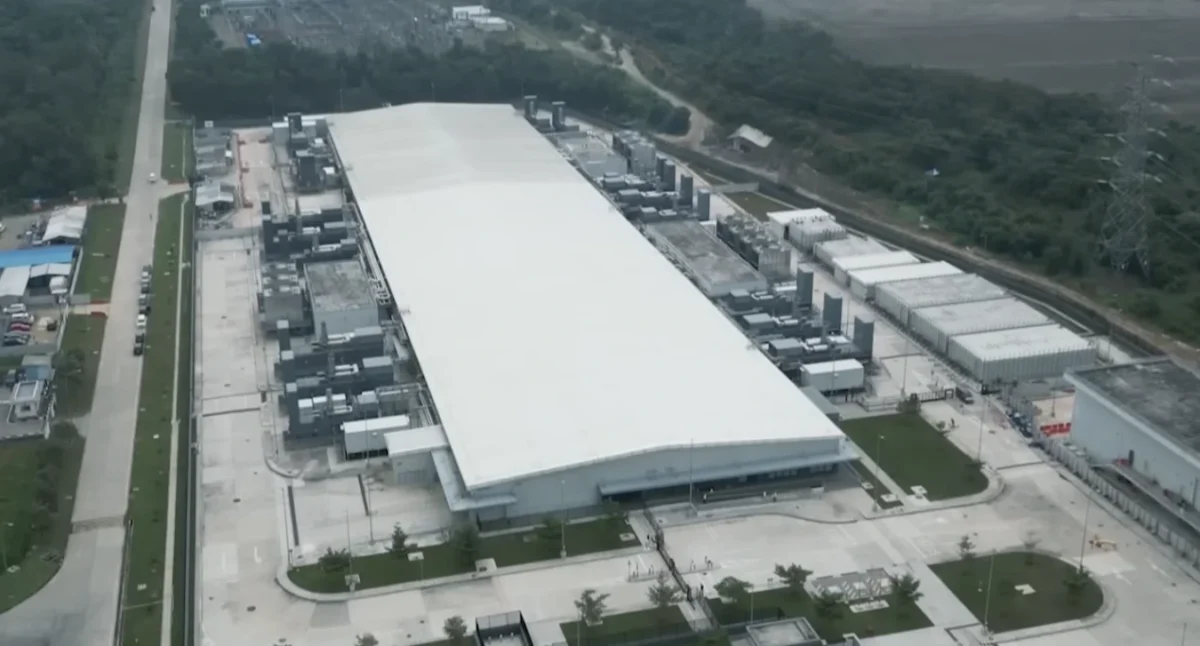
Something significant is being built in the fields of West Java. Rising from the Karawang International Industrial City, a 48-megawatt facility under construction will soon become one of Microsoft’s newest data centers in Asia , part of a USD 1.7 billion commitment to Indonesia that the technology giant has described as a long-term, multi-decade investment.
Microsoft is not alone. Digital Edge, backed by global alternative asset manager Stonepeak, has announced a USD 4.5 billion data center campus in Bekasi that will eventually deliver up to 500 megawatts of IT capacity, the company’s largest infrastructure commitment anywhere in the world. Amazon Web Services, Alibaba, and ST Telemedia GDC are among the other names accelerating their footprints in the country.
The numbers tell a striking story. Indonesia’s data center market, valued at approximately USD 2.81 billion in 2025, is projected to reach USD 6.08 billion by 2031, a compound annual growth rate of nearly 14%. Capacity, measured in megawatts, is expected to more than double from around 1,440 megawatts in 2025 to over 3,500 megawatts by 2030.
Indonesia is not just growing. It is positioning itself as the defining data center hub of Southeast Asia, and understanding why requires examining four interconnected forces: demand, investment, sustainability, and talent.
Why Indonesia? The Foundations of the Boom
Southeast Asia’s Largest Digital Economy
Indonesia’s appeal to global data center investors begins with a simple fact: it is home to Southeast Asia’s largest digital economy, underpinned by a population of over 272 million people, the fourth largest in the world.
Digital consumption is growing at every level. E-commerce platforms process millions of transactions daily. Video streaming services serve an increasingly mobile-first population. Artificial intelligence tools are beginning to enter the mainstream across enterprise, government, and consumer applications. Every one of these activities generates demand for computing power, and computing power requires data centers.
When an online purchase is made, a video is streamed, or a question is directed at an AI assistant, the request travels to a data center where thousands of powerful servers process and return the response in seconds. Without that infrastructure, the digital services that hundreds of millions of Indonesians now rely on daily would simply not function at scale.
Land, Power, and Connectivity
Beyond pure demand, Indonesia offers the physical prerequisites that large-scale data center development requires: available land, access to power infrastructure, and growing submarine cable connectivity that links the archipelago to global internet networks.
The greater Jakarta area, encompassing Karawang, Bekasi, and the capital itself , has emerged as the primary concentration zone for data center development, combining proximity to the country’s largest business and consumer markets with the industrial land and power access that hyperscale operators demand.
Jakarta’s position is reinforced by its extensive fibre network and its role as a landing point for international submarine cables. Data center capacity in Jakarta is the anchor; the city’s domestic demand drives investment, and from that base, Indonesia can credibly aspire to serve regional data flows as well.
Government Ambition and Regulatory Direction
Indonesia’s government has moved beyond passive observation of the data center boom. Officials have explicitly identified data center investment as a national priority, committing to provide dedicated regulatory treatment, fiscal incentives, and an improved investment climate for operators.
One model under active consideration is the Special Economic Zone (SEZ) framework, already applied at Batam’s Nongsa Digital Park, which has benefited from its proximity to Singapore and its SEZ status to attract data center investment. Operators including Digital Edge have publicly urged authorities to extend SEZ designation to more data center clusters, particularly in areas with sufficient land, water, power, and connectivity. SEZ status brings significant fiscal and non-fiscal incentives that materially affect the economics of large-scale infrastructure projects with decades-long time horizons.
Regulatory certainty is the other pillar operators emphasise consistently. Data centers are built to last for 30 years or more. The infrastructure decisions made today, facility design, power contracts, cooling systems, network architecture, will still be operating well into the 2050s. Operators require confidence that the rules governing their investment will remain stable and predictable across those timescales. In a country undergoing rapid regulatory modernisation, that predictability is something the government is actively working to deliver.
The Investment Landscape: Who Is Building What
Microsoft’s Karawang Cluster
Microsoft’s investment strategy in Indonesia is one of the most closely watched commitments in the regional technology sector. The company’s USD 1.7 billion programme centres on a cluster of data centers at the Karawang International Industrial City in West Java, with plans for a total of five facilities on the same campus forming a major regional hub.
The first facility, the Indonesia Central Azure Region, launched in May 2025, marked a significant milestone as only the second Microsoft cloud region in Southeast Asia after Singapore. The current facility under construction at Karawang adds a further 48 megawatts of capacity, with additional tranches of land reserved for future expansion that could eventually take the campus to hundreds of megawatts.
Microsoft has also secured a 10-year renewable energy agreement with PLN, Indonesia’s state electricity company, covering 200 megawatts of solar energy. This positions the Karawang cluster to draw from a substantially greener grid than would otherwise be available, advancing both Microsoft’s global sustainability commitments and Indonesia’s renewable energy development.
The company estimates its Indonesia programme will contribute approximately USD 2.5 billion to the national economy and create around 60,000 jobs by 2028, figures that illustrate the macroeconomic significance of hyperscale data center investment beyond the facilities themselves.
Digital Edge’s CGK Campus: Indonesia’s Largest Data Center Project
Singapore-headquartered Digital Edge has made Indonesia its largest market by both investment value and power capacity. The company already operates two facilities in central Jakarta, including the EDGE2 data center launched in 2024, a 23-megawatt facility housing more than 3,400 server racks that currently ranks as the largest data center in the heart of the Indonesian capital.
The CGK Campus in Bekasi, West Java is the next chapter in that story, and it is extraordinary in scale. The planned facility will deliver 500 megawatts of IT capacity at full build-out, with potential to expand to 1 gigawatt. Digital Edge has committed USD 4.5 billion to the project, making it the company’s largest single infrastructure investment globally. Construction is proceeding in phases, with the first building scheduled to enter service in the fourth quarter of 2026.
The CGK Campus has been engineered specifically for AI workloads, featuring direct-to-chip liquid cooling, a technology that is rapidly becoming essential as the density of AI-optimised GPU hardware generates heat levels that traditional air-cooling systems cannot manage effectively.
The Broader Investment Picture
Beyond Microsoft and Digital Edge, DAMAC Digital has announced a USD 2.3 billion commitment for a Jakarta data center focused on AI-ready infrastructure. PT DCI Indonesia, the country’s largest domestically listed data center company, continues to expand. AWS, Alibaba, and Korea Investment Partners have all deepened their exposure to Indonesian digital infrastructure.
The cumulative weight of these commitments reflects a shared judgement among the world’s most sophisticated infrastructure investors: Indonesia’s digital growth trajectory justifies decade-scale capital allocation at scale.
The Sustainability Imperative: Building Green in a Coal-Heavy Grid
Data centers are among the most energy-intensive built environments in existence. A large-scale facility operates 24 hours a day, 365 days a year, drawing continuous power for both computing and cooling. A single 100-megawatt data center consumes roughly as much electricity as a mid-sized city.
This energy intensity sits in uncomfortable tension with Indonesia’s current electricity mix, which still relies heavily on coal-fired generation. For multinational operators whose global clients have firm decarbonisation commitments, managing carbon exposure in an energy system where renewables remain expensive and undersupplied is a genuine operational and commercial challenge.
Cooling Innovation: From Air to Liquid
Approximately half of a data center’s power consumption goes to IT equipment; much of the remainder goes to keeping that equipment cool. As AI accelerates and GPU-based computing becomes standard, the thermal density of server hardware is increasing dramatically, requiring cooling approaches that conventional air conditioning systems were not designed to handle.
The industry’s response is direct-to-chip liquid cooling. Rather than circulating cool air through the data hall, this approach runs a closed loop of cooling liquid directly over the processing chips inside each server. The liquid absorbs heat at the source, carries it through the system to external cooling towers where it is dissipated, and is then recirculated. The result is significantly more efficient heat removal, lower power consumption for cooling, and the ability to support the extreme thermal loads generated by AI-optimised hardware.
Digital Edge’s CGK Campus will deploy this technology at scale, alongside recycled water systems and renewable energy integration, setting a benchmark for sustainability practice in the Indonesian market.
Microsoft’s Renewable Energy Commitment
Microsoft has pledged to become water positive by 2030, meaning it will return more water to the environment than its operations consume, and has committed that 100% of its electricity consumption in Indonesia will be matched with renewable energy through partnerships with local ecosystem providers.
The 10-year power purchase agreement with PLN for 200 megawatts of solar energy is the cornerstone of this commitment. By embedding renewable energy agreements into long-term supply contracts, Microsoft is helping to finance new solar generation capacity in Indonesia while securing the green energy supply its sustainability targets require.
Indonesia’s Green Rating System
A new sustainability index for the data center sector is under development in Indonesia, designed to provide a standardised national rating framework for energy efficiency and environmental performance. Industry associations are working toward a system under which every data center in the country can demonstrate its sustainability credentials against a defined set of criteria.
Observers note that the rating system’s long-term effectiveness will depend on whether it is linked to meaningful incentives, tax benefits being the most frequently cited, and whether national-level regulatory support is forthcoming to give operators a concrete reason to participate. The dual levers of regulatory requirement and favourable policy incentive are both considered necessary to drive broad adoption.
The Talent Challenge: Building the Workforce Behind the Infrastructure
Physical infrastructure can be planned, financed, and constructed on a defined timeline. The human capital required to operate it is a more complex and longer-cycle challenge, and it is one that analysts consistently identify as the binding constraint on Indonesia’s data center ambitions.
Why Data Center Talent Is Uniquely Difficult to Develop
Data centers are multidisciplinary environments. Operating and maintaining a large-scale facility requires expertise that spans IT systems, mechanical and electrical engineering, facilities management, sustainability compliance, and AI operations, a combination that does not map neatly onto any single university curriculum or vocational training pathway.
Two talent profiles are particularly scarce globally: data center operations specialists and AI operations specialists. Unlike general IT or engineering graduates, these roles require facility-specific knowledge that is simply not taught in standard degree programmes. Tertiary education provides a foundation, but specialised post-graduation training is essential.
The challenge is compounded by the inherently closed nature of the industry. Data centers are critical infrastructure, operating under strict security protocols that limit access and information sharing. Operators are cautious about what they disclose publicly, some facilities carry no company signage at their entrance. This secrecy, while understandable from a security perspective, creates a significant gap between what training institutions can teach and what the industry actually needs.
Nusantara Data Center Academy: Bridging the Gap
Established in 2022, the Nusantara Data Center Academy was created specifically to address this talent shortage. The academy offers a structured programme for young professionals that combines six months of classroom-based training in data center management with six months of on-the-job training, followed by industry placement.
The Nusantara Academy’s model, which its founders describe as the Panther Helix framework, brings together educational institutions, global industry partners, government bodies, and media channels to build a connected ecosystem around the training programme. It has partnered with polytechnics to offer tailored internship and placement pathways, and collaborates with global industry bodies to provide internationally recognised certifications in data center design, sustainability, and safety.
Digital Edge has partnered with the Nusantara Academy since 2024, hiring eight of its graduates and providing the on-the-job training environment that the programme requires. This kind of direct operator engagement is precisely what analysts argue is necessary to close the talent gap, and what the industry’s historically closed culture has made difficult to achieve at scale.
Microsoft’s AI Skilling Programme
Microsoft is approaching the talent challenge at a different level of scale. Through its “Elevate” programme — a national AI skilling initiative — the company worked with government agencies across Indonesia to train 1.1 million individuals in AI skills in a single year.
This programme reflects a recognition that Indonesia’s data center ambitions require not just operational staff but an ecosystem of AI-literate professionals across every sector of the economy. Cloud computing and AI infrastructure only generate economic value when a workforce capable of using them exists at scale.
What the Growth Means: Indonesia’s Digital Future
The data being tracked by industry analysts is striking in its scale. Indonesia’s data center capacity stood at approximately 900 megawatts in 2023. Projections suggest the figure will reach close to 2,000 megawatts by 2028, a doubling in five years. By 2030, capacity is expected to exceed 3,500 megawatts.
Behind those numbers is a straightforward story: Indonesia has the population, the digital economy trajectory, and the physical prerequisites to be a major data center hub, and the world’s largest technology investors have concluded that the opportunity justifies multibillion-dollar, decade-scale commitments.
The analogy that frames this moment well is one the industry itself has adopted: if data is the new oil, data centers are the refineries of the digital age. Indonesia, sitting on vast reserves of digital demand, is building the processing infrastructure to convert that demand into economic value, for its own citizens, and for the broader digital economy of Southeast Asia.
Whether Indonesia fully realises that potential will depend on how well the government translates its ambitions into consistent policy, how effectively the industry addresses its sustainability obligations, and how successfully the talent pipeline keeps pace with the physical infrastructure being built around it.
The investment, the infrastructure, and the ambition are all in place. The execution is what will define the decade.
Key Takeaways
- Indonesia’s data center market is projected to grow from USD 2.81 billion (2025) to USD 6.08 billion by 2031, at a CAGR of nearly 14%
- Microsoft is investing USD 1.7 billion in a Karawang-based cluster with five planned facilities and a 200-megawatt renewable energy agreement with PLN
- Digital Edge has committed USD 4.5 billion to its CGK Campus in Bekasi, a 500-megawatt AI-ready facility and the company’s largest global investment
- Indonesia’s government is actively pursuing SEZ designation for data center clusters and dedicated regulatory frameworks to attract further investment
- Sustainability is a critical pressure point: liquid cooling and renewable energy agreements are becoming standard features of new builds
- The talent shortage remains the sector’s most significant structural constraint, being addressed through academies like Nusantara and hyperscaler skilling programmes
Related Reading
Indonesia’s data center expansion is one chapter in a much larger global story. To understand the full context — the technology driving the demand, the scale of the players involved, and the challenges operators must navigate — the following guides are essential reading.
To understand why data centers exist at all and why they have become the indispensable backbone of modern life, start with Why the World Needs Data Centers: The Invisible Engine of Our Modern Lives. It explains the foundational role these facilities play in everything from online banking to emergency services, context that makes Indonesia’s buildout ambitions immediately legible.
The investors pouring billions into Indonesia are predominantly hyperscalers — the cloud giants whose infrastructure commitments define the global data center landscape. Hyperscale Data Centers: The Giants Behind the Cloud breaks down how these organisations operate, what sets them apart from conventional colocation facilities, and why their investment decisions carry such outsized consequences for the regions they enter.
One of the most important design choices in Indonesia’s emerging facilities — including Digital Edge’s CGK Campus, is the move toward modular and edge computing architectures. Modular and Micro Data Centers: Computing on the Edge explains how this approach allows operators to deploy capacity faster, closer to end users, and with greater scalability than traditional monolithic builds.
Sustainability is no longer optional for data center operators serving multinational clients with carbon commitments. The deep dive into Sustainability and Green Data Centers: Powering the Digital World Without Costing the Earth covers the full spectrum of green strategies, from renewable energy procurement and liquid cooling to water recycling and carbon reporting, giving essential context to the environmental pressures Indonesia’s operators are navigating right now.
Security is the dimension of data center operations that receives the least public attention precisely because it matters most. As Indonesia handles growing volumes of sensitive personal, commercial, and government data, Security Challenges in Modern Data Centers: Guarding the Digital Fortress examines the layered physical and cyber threats these facilities face and the defensive frameworks operators deploy in response.
Indonesia’s push to assert control over data generated within its borders, including regulations requiring domestic storage of certain data categories, sits within a rapidly evolving global debate. Data Sovereignty and the Geopolitics of Data Centers: The New Borders of the Digital World maps how governments worldwide are using data localisation policy as a tool of economic and political sovereignty, and what that means for operators navigating multiple regulatory jurisdictions.
Finally, looking beyond the silicon technologies that define today’s data centers, Quantum Computing and the Future of Data Storage: A New Dimension explores the next technological frontier, one that could fundamentally transform how data is stored, processed, and secured in the decades ahead. For a country building infrastructure designed to last 30 years or more, understanding what quantum computing may eventually demand is not a distant concern but an urgent planning consideration.