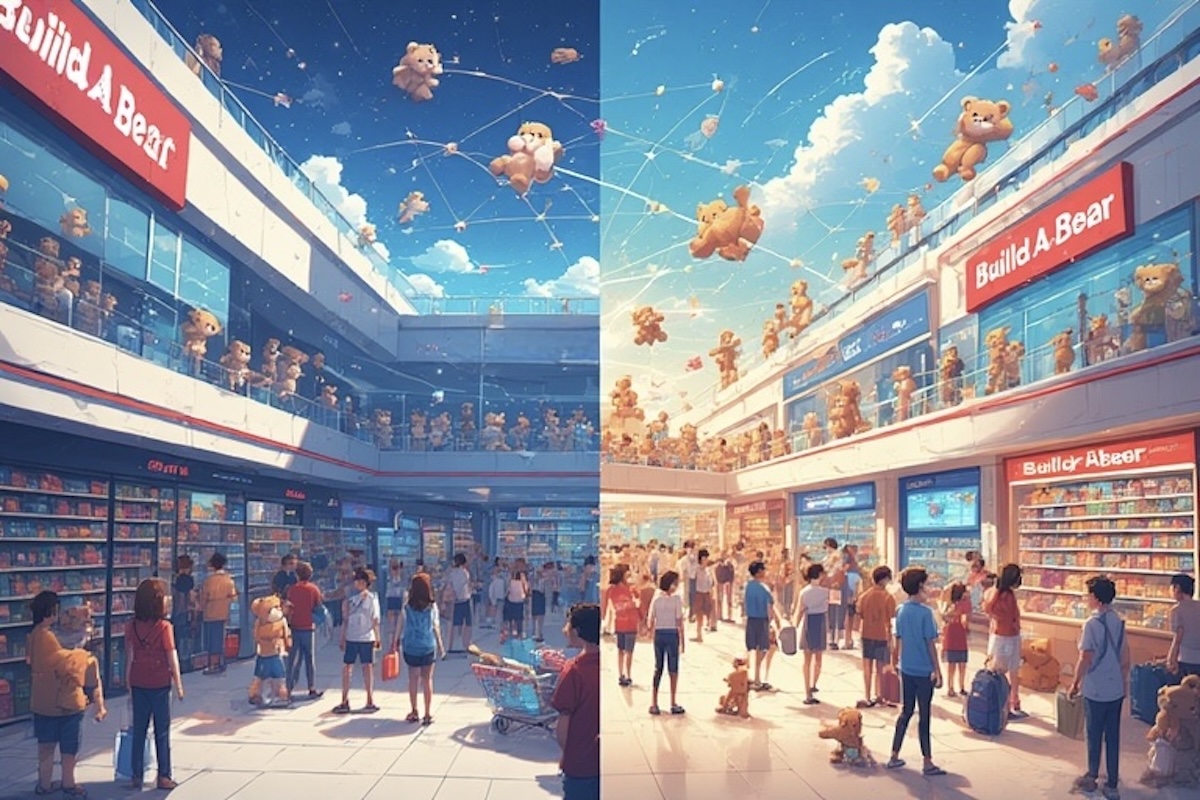
For years, the sight was familiar: a colorful storefront tucked inside a shopping mall, drawing children toward shelves of plush animals waiting to be brought to life. Few would have guessed that this once-struggling mall retailer would later become one of the most compelling retail brand comeback stories in modern consumer business.
Yet that is exactly what happened. Through a carefully executed consumer brand turnaround, Build-A-Bear quietly rewrote its future—transforming itself from a mall-dependent toy chain into a diversified global brand on the brink of surpassing $500 million in annual revenue.
The Rise, the Fall, and the Emotional Core
Build-A-Bear was founded in 1997 with a simple but powerful idea: selling not just a product, but an experience. Customers didn’t merely buy a stuffed animal—they created it. From choosing the plush to participating in a heart ceremony, the brand pioneered what is now widely recognized as experiential retail.
Early enthusiasm, however, did not shield the company from structural change. After the 2008 financial crisis, mall traffic declined sharply. Shoppers migrated online, and the business struggled to adapt. Sales weakened, losses mounted, and the stock price collapsed. By the early 2010s, the brand was beloved, but the business behind it was broken—an all-too-common story in the era of declining malls.
How Build-A-Bear Turned Around Its Business
The turning point came when leadership reframed the challenge. Instead of rebuilding the brand, the focus shifted to rebuilding the business itself. The Build-A-Bear turnaround strategy centered on profitability first, growth second.
Underperforming stores were closed. Locations were redesigned. New workshops opened not just in malls, but in high-traffic tourist destinations, theme parks, and premium retail hubs. This mall retailer revival strategy repositioned stores as destinations rather than dependencies.
Crucially, the company stopped viewing itself as a children-only brand. By leveraging entertainment partnerships and nostalgia-driven designs, it unlocked Build-A-Bear sales growth among teens and adults. Adult customers now represent roughly 40% of total sales—double their share from a decade earlier.
The Digital Pivot That Changed Everything
One of the most important shifts was the long-overdue Build-A-Bear e-commerce expansion. Beginning in the mid-2010s, the brand invested heavily in a mobile-first digital platform, virtual workshops, and a loyalty ecosystem.
This wasn’t just about selling online. Digital channels became a testing ground for new products and a gateway to older audiences who might never step into a mall. Operational efficiency improved as stores began fulfilling online orders, slashing delivery times from weeks to days.
This e-commerce transformation in retail turned physical stores into profit centers rather than cost burdens. Today, virtually all locations operate in the black—a rare achievement in brick-and-mortar retail.
A Global Retail Expansion Strategy Takes Shape
Beyond domestic recovery, the brand pursued an ambitious Build-A-Bear international expansion. Through a franchise-heavy model, workshops now operate in more than 30 countries. This approach minimizes capital risk while delivering strong margins, with franchise operations generating operating margins estimated between 20% and 30%.
Several markets have shown overwhelming demand, with new store openings drawing long lines and signaling significant untapped potential. This global retail expansion strategy has become a key pillar of long-term growth.
Build-A-Bear Stock Surge and Financial Performance
The financial results have been dramatic. After falling below $1 per share during the pandemic, the stock staged a historic rebound. From late 2020 to late 2025, the Build-A-Bear stock surge exceeded 1,150%, at times outperforming major technology companies.
Despite tariff pressures that trimmed profits and caused short-term volatility, the company reported the most profitable nine-month period in its history in 2025. Revenue continues to climb, with management projecting that annual sales will surpass $500 million for the first time ever.
This Build-A-Bear financial performance analysis reveals a business that has learned how to balance growth, pricing discipline, and customer loyalty—even in a challenging macroeconomic environment.
Risks, Resilience, and the Future Growth Outlook
Challenges remain. Heavy reliance on overseas manufacturing exposes the company to tariffs and geopolitical risk. Inflation and consumer sentiment can also weigh on discretionary spending. Still, the brand has shown resilience by offering accessible price points and introducing lower-cost product lines that preserve customer engagement.
Perhaps most importantly, the emotional nature of the product limits returns—few customers bring back something they personally created. That emotional bond continues to differentiate the business in a crowded retail landscape.
Looking ahead, the Build-A-Bear future growth outlook rests on three pillars: profitable physical stores, scalable digital commerce, and high-margin international franchising. Together, they form a blueprint for sustainable growth that few former mall retailers have managed to achieve.
A Modern Build-A-Bear Investment Story
What began as a simple mall attraction has evolved into a compelling Build-A-Bear investment story—one that illustrates how legacy brands can adapt, modernize, and thrive. By embracing change without abandoning its core identity, Build-A-Bear has proven that even in an era of disrupted retail, a well-executed comeback is still possible.