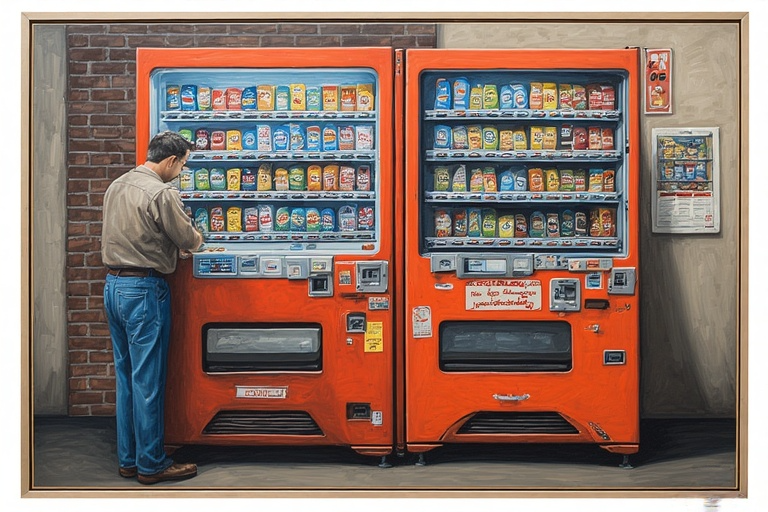
Adam Hill was stuck in the corporate grind, dreaming of freedom and flexibility. Eight years ago, he made a bold decision that would change his life forever—he invested $120,000 in something most people walk past every day without a second thought: vending machines.
Today, Hill Vending generates over $50,000 in monthly revenue, operates approximately 100 machines, and runs one of the most efficient vending operations in the country. But Hill’s journey wasn’t without painful lessons, expensive mistakes, and moments of doubt.
The Accidental Entrepreneur’s Origin Story
Hill’s entry into the vending industry happened almost by chance. While working his nine-to-five corporate job, he struck up a conversation with the vendor who serviced his workplace machines. That casual conversation evolved into a business opportunity when the vendor expressed interest in selling his route.
Hill wanted something with more freedom and flexibility, so he took the leap and bought a vending route with absolutely no experience.
The price tag? A substantial $120,000—$60,000 down with owner financing for the remaining balance paid over three years. Hill pooled resources with his father and brother, who believed in his vision enough to invest in what would become a successful family business.
The $300 Machine That Could Cost You Everything
Before aspiring vending machine entrepreneurs rush out to buy their first machine, Hill has a critical warning that could save them thousands of dollars.
The biggest mistake Hill sees people make is thinking every vending machine is the same. A $300 machine is not the same as a $3,000 machine, and there’s a substantial reason for the price difference.
The market is flooded with outdated equipment that can’t accommodate modern credit card readers, has incompatible parts, or uses technology that’s no longer supported. These bargain machines quickly become expensive paperweights.
Hill learned this lesson the hard way, making mistakes along the way with identifying which machines are good and which are bad.
His recommendation for beginners? Invest in quality equipment from the start. Specifically, he suggests:
- Vendo 721 series drink machines (the “Cadillac” of vending machines): $4,000-5,000 new, approximately $2,000-2,500 used
- AMS brand snack machines: Known for reliability, easy maintenance, inexpensive parts, and simple programming
These quality machines offer durability, reliability, and resale value—meaning if vending isn’t the right fit after a few months, entrepreneurs can recoup most of their investment.
The Four Keys to Vending Success
Hill has distilled his eight years of experience into four essential elements. Master all four, and profitability follows.
1. Location: The Make-or-Break Factor
According to Hill, vending is all about locations and foot traffic. The more people that come across a machine, the higher volume and sales it produces.
But not just any location will do. Hill developed what he calls the “Prospect Pyramid”—a guide that helps determine location viability based on foot traffic:
- Minimum viable location: 50 people (employees, customers, or visitors)
- Sweet spot for beginners: 100 people in foot traffic
- High-volume locations: 200+ people
Hill also follows the “30-30 rule”—keeping all locations within a 30-minute, 30-mile radius of his warehouse. This maximizes efficiency and minimizes drive time for service calls.
Expanding territory so large that operators are driving two hours in one direction creates inefficiency. If something requires attention and a machine needs fixing, that becomes a two-hour round trip just to remove a coin jam.
2. Machines: Quality Over Quantity
Beyond choosing the right brands, Hill recommends a specific setup for maximum profitability.
Operators should never start with just one machine. Instead, they should opt for a full-size drink machine paired with a snack machine. This combination holds enough product to justify return visits and generates sufficient revenue to make locations worthwhile.
Hill advises against combo machines (which hold both snacks and drinks in one unit) for busy locations—they empty too quickly, requiring excessive service visits that eat into profits.
3. Service: The Secret Weapon
Here’s a surprising revelation: 90% of the accounts that contact Hill Vending already have vending machines. They’re not looking for machines—they’re looking for reliable service.
Service is the number one lacking trait of the majority of vending businesses, according to Hill. Many mom-and-pop operations run vending on the side, and machines end up empty with customers unable to use them.
This service gap represents the biggest opportunity for new operators. Even large national companies sometimes spread themselves too thin, neglecting smaller accounts. Hill Vending has built its reputation by focusing on consistent, reliable service—and it’s their primary competitive advantage.
Hill’s service philosophy is straightforward: if customers aren’t happy, he’ll remove the machines. He stands by his service quality and puts clients in complete control.
4. Pricing: The Profitability Formula
Hill operates by the “50-30-20 rule” for profit margins:
- 50% of revenue goes to product costs
- 30% is take-home (for owners or employees)
- 20% covers miscellaneous expenses (credit card fees, gas, insurance)
For individual products, the minimum markup is 100%. If a can of soda costs 50 cents, it should sell for at least one dollar. However, pricing varies by location type:
- Workplace environments: $1.00-1.25 for standard items
- Resort or tourist locations: $2.00-3.00 (customers expect and accept higher prices)
The key is knowing the audience and finding the balance between profit margin and sales volume.
Starting From Zero: The Low-Cost Entry Strategy
The beauty of the vending business is its accessibility. Aspiring operators don’t need $120,000 or a warehouse to begin.
Entrepreneurs can definitely start this business from home, Hill confirms. He knows people who operate out of their SUVs.
When he started, Hill stored inventory in his living room, working with his brother before expanding. Here’s the progression:
Phase 1: Home-Based Operation
- Store product in a garage or spare room
- Start with 2-4 machines
- Service locations personally using a personal vehicle
- Total startup investment: $5,000-15,000
Phase 2: Small Storage Unit
- Rent a storage unit for high-volume items
- Expand to 10-20 machines
- Consider a used cargo van or small truck
- Monthly overhead: $200-500
Phase 3: Dedicated Warehouse
- Move to commercial space when approaching 50+ machines
- Hire part-time or full-time help
- Hill Vending operates from 1,600 square feet at $1,600/month
Finding the First Locations: The Outbound Strategy
For small operations, Hill recommends outbound sales as the cheapest, most effective growth strategy.
Going into locations, finding out if they have vending, discovering whether they’re unhappy with current service, and offering solutions—that’s the cheapest and most effective approach.
But operators shouldn’t just drive around aimlessly. Hill’s systematic approach includes:
- Research before driving: Use Google Maps to identify potential locations by examining parking lots to estimate employee counts
- Target manufacturing plants and offices: Look for buildings with 50-100+ vehicles
- Qualify before visiting: Call ahead when possible, but face-to-face meetings often work best
- Network strategically: Talk to people at church, schools, and within local networks about vending needs at their workplaces
Hill even secured one major account by striking up a conversation with a training facility director at Sam’s Club. He noticed the logo the director was wearing and asked about their vending situation. They were having issues, so they set up a meeting and Hill took over the account.
The Follow-Up Factor: Persistence Pays
One critical mistake new operators make is giving up too quickly. The vending sales cycle is longer than many expect.
It’s not just going to be a one-time meet and greet, Hill cautions. Operators need to follow up with contacts and make sure they remain top of mind.
His follow-up strategy is refreshingly old-school:
- Contact prospects every couple weeks
- Vary communication methods (phone, email, in-person)
- Continue until they explicitly ask to stop or they sign
- Focus on offering value and solving their specific problems
The Smart Sourcing Strategy
Surprisingly, Hill doesn’t work with major distributors like Coca-Cola or Pepsi directly—and there’s a smart reason why.
Ninety percent of Hill’s warehouse inventory comes from Sam’s Club.
The economics are compelling:
- Sam’s Club price for Sprite: $0.50 per can
- Direct from Coca-Cola: $0.75 per can
That 50% price difference directly impacts the bottom line. Hill Vending strategically located their warehouse less than a mile from Sam’s Club, allowing them to place online orders and pick up inventory quickly without delivery fees.
The lesson? Source from wherever offers the best price. When selling hundreds of cans weekly, those quarters add up quickly.
Avoiding the Expansion Trap
One of Hill’s early mistakes nearly derailed his business: trying to do too much, too soon.
When he first started, Hill was trying to handle vending machines, frozen food machines, and coffee machines simultaneously. He didn’t have expertise in anything.
The turning point came when he cut back and hyperfocused on snack and drink machines exclusively. That’s when things really changed for his business.
This lesson applies to all aspects of the vending business. Rather than chasing every possible location, Hill Vending maintains strict criteria based on their 30-30 rule. If a location doesn’t hit their criteria for foot traffic in their service radius, they don’t pursue it.
This disciplined approach has created remarkable efficiency. Hill believes there’s no one else in the country doing the level of sales his company achieves out of one box truck in a vending business.
Building a Team: From Solo to Scalable
Hill operated solo for the first couple of years before bringing on his brother, then later his brother-in-law. This gradual expansion allowed him to maintain quality while scaling.
Today, the team structure is straightforward:
- Two drivers: Handle Monday-Friday route service with the box truck
- Hill: Manages backend operations (paperwork, inventory, machine moves, service calls)
When operators work solo, they’re handcuffed to the business and have to be there all the time.
Building a team freed Hill to focus on growth while ensuring customer satisfaction remained high.
The Credit Card Reader Revolution
Five years ago, credit card readers were optional. Today, they’re becoming essential.
Hill predicts that in five years, all machines will have card readers. Some operators are even going entirely cashless.
The setup isn’t free:
- Card reader device (Cantaloupe brand): $300
- Monthly cell service: $10 per machine
For six machines at a location, that’s $60 monthly in connectivity fees—but the increase in sales typically far outweighs the cost. Modern consumers expect card payment options, and machines without them lose potential sales.
Newer machines also offer advanced features like guaranteed delivery systems with laser sensors that ensure products actually drop, reducing customer complaints and refund requests.
Finding Routes to Buy
Entrepreneurs who prefer buying an existing route rather than building from scratch have several options:
- Route For Sale websites: Online marketplaces listing vending routes alongside other businesses
- Direct outreach: Google vending companies in the desired area and call them directly
- Word of mouth: Many routes sell through personal networks before hitting public listings
When buying, creative financing is often available. Hill paid $120,000 with $60,000 down and owner financing for the balance. The machines and locations themselves served as collateral.
Those who really want to enter the business will find a way through conversations and negotiations. Owner financing terms might include 12-month notes at 10% interest, though everything is negotiable based on the seller’s situation.
The Product Selection Science
After years of experience across 100 machines, Hill has identified the core staples:
Drink Machines (every machine includes):
- Coca-Cola (top seller)
- Mountain Dew (second-best seller)
- Bottled water
- Additional selections vary by location (ginger ale, tea, etc.)
Snack Machines (organized by row):
- Large bagged chips: $1.00
- Small bagged chips: $1.25
- Cookie row
- Chocolate row
- Non-chocolate row
- Bottom row: Pastries and honey buns
This organization system serves multiple purposes. It makes restocking efficient, allows easy substitutions when specific products are out of stock, and simplifies training for team members.
If Cheetos are out of stock, operators can substitute with another similar item at the same price point and know exactly where it goes in the machine.
Maintenance Made Simple
Contrary to expectations, operators don’t need technical expertise to run a vending machine business.
Most parts are plug and play, according to Hill. If a coin mechanism goes bad, operators turn the machine off, unplug it, get a new one, and install it.
For complex issues like refrigeration repairs, Hill sends components to repair technicians rather than attempting fixes in-house. His 1,600-square-foot warehouse includes a modest work area for basic maintenance and installations, but the business doesn’t require extensive mechanical skills.
Modern machines with cell connectivity also allow remote monitoring. Anything with a credit card reader can be accessed remotely for live diagnostics. This technology catches problems before customers even notice them.
The Reality Check: What New Owners Need to Know
Hill offers final advice grounded in protecting new operators from financial loss.
At the end of the day, he doesn’t want aspiring entrepreneurs to lose money. They’re going to invest thousands of dollars in equipment, and he wants them to buy quality machines so that if they discover vending isn’t for them in a couple months, they can sell their equipment and recoup their investment.
This philosophy reflects Hill’s genuine desire to see others succeed. Rather than overpromising easy money, he’s realistic about challenges while enthusiastic about opportunities.
The vending machine business offers genuine potential for those willing to focus on the fundamentals: quality machines, profitable locations, exceptional service, and smart pricing. It’s not a get-rich-quick scheme, but a legitimate business model that rewards consistency, attention to detail, and customer focus.
Hill started with no experience eight years ago. Today, Hill Vending generates over $50,000 monthly with a lean team and efficient operations. The path is clear for those willing to follow the blueprint he’s laid out.
The question isn’t whether the opportunity exists—it clearly does. The question is whether aspiring entrepreneurs are ready to take the first step, invest in quality equipment, and commit to providing the exceptional service that most vending operators neglect.
That gap in the market? It’s waiting for someone to fill it.
Ready to start a vending machine business? The industry is ripe with opportunity for operators who prioritize service and follow proven strategies. With careful planning, quality equipment, and dedication to customer satisfaction, entrepreneurs could build their own profitable route—perhaps even from the comfort of their own garage.