Imagine you’re a scientist testing a new drug, a student verifying a physics experiment, or a quality control manager checking product dimensions. You take measurements, but the results don’t match the expected values. How far off are you?
That’s where percent error comes in—a crucial calculation that tells you how accurate your measurements are compared to the true or accepted value.
In this guide, we’ll break down what percent error is, why it matters, and how to calculate it step-by-step—with real-world examples anyone can understand.
What Is Percent Error?
Percent error measures how much a measured value deviates from the true or accepted value, expressed as a percentage.
Why It Matters:
✔ Science & Research: Ensures experimental accuracy.
✔ Manufacturing: Maintains product quality control.
✔ Everyday Life: Helps assess measurement reliability (e.g., weather forecasts, medical tests).
Example:
If a scale says you weigh 150 lbs, but your true weight is 145 lbs, the percent error tells you how “off” the scale is.
The Percent Error Formula
The formula for percent error is:
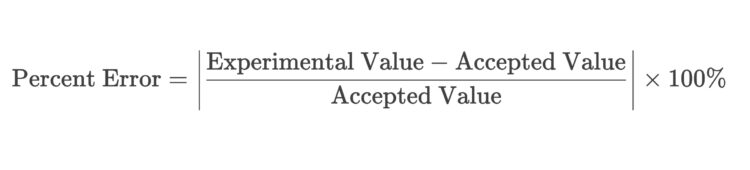
Where:
- Experimental Value (EV) = Your measured result
- Accepted Value (AV) = The true or expected value
- | | = Absolute value (ignore negative signs)
Step-by-Step Calculation (With Examples)
Example 1: Lab Experiment
Scenario:
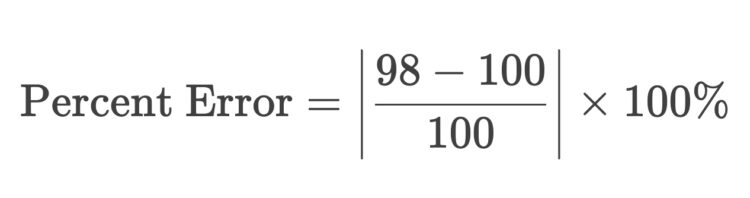
You measure the boiling point of water as 98°C, but the accepted value is 100°C.
Step 1: Plug into the formula.
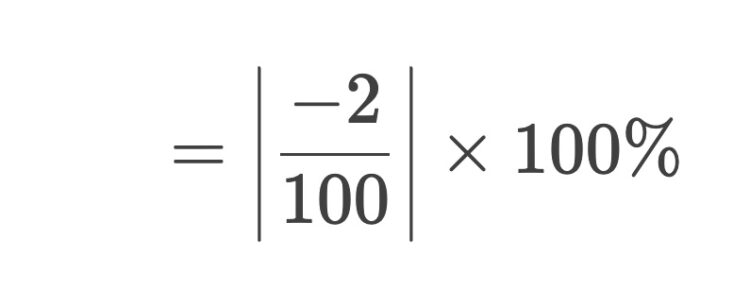
Step 2: Subtract.
Step 3: Take absolute value (drop the negative).
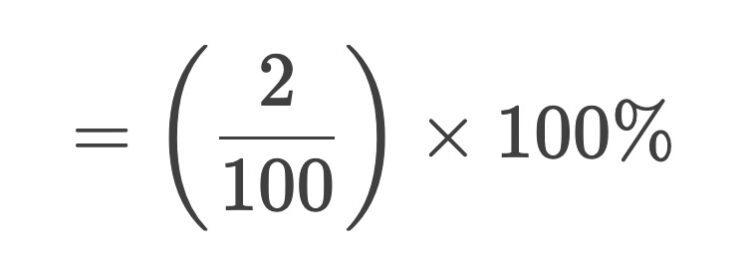
Step 4: Multiply by 100%.
= 0.02 x 100% = 2%
Conclusion: Your measurement has a 2% error.
Example 2: Business Forecasting
Scenario:
A company predicts 500 sales, but actual sales are 475.
Step 1: Plug into the formula.
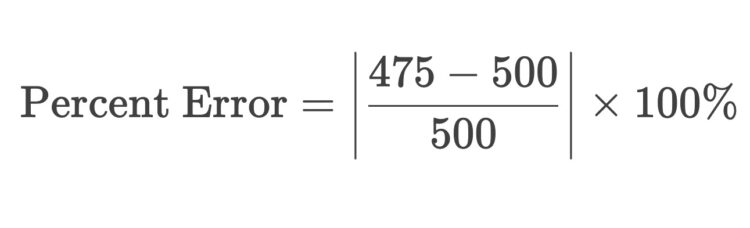
Step 2: Simplify.
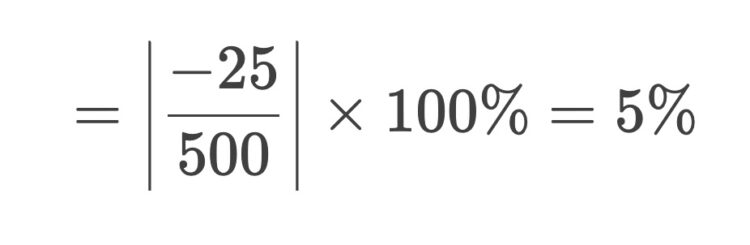
Conclusion: The forecast was 5% off.
When to Use Percent Error
| Field | Application | Example |
|---|---|---|
| Science | Lab experiments, physics | Measuring gravity (9.8 m/s² vs. 9.7 m/s²) |
| Engineering | Product testing, tolerances | A bolt’s length should be 10 cm (±2%) |
| Finance | Budget vs. actual spending | Projected $1M revenue, actual $950K |
| Medicine | Dosage accuracy | Prescribed 50mg, administered 52mg |
Percent Error vs. Related Concepts
1. Percent Error vs. Percent Difference
- Percent Error: Compares one measured value to a true value.
- Percent Difference: Compares two experimental values (neither is “true”).
Formula for Percent Difference:

2. Percent Error vs. Absolute Error
- Absolute Error: Just the numerical difference (e.g., “2°C off”).
- Percent Error: The relative difference as a % (e.g., “2% off”).
Common Mistakes (And How to Avoid Them)
❌ Ignoring Absolute Value
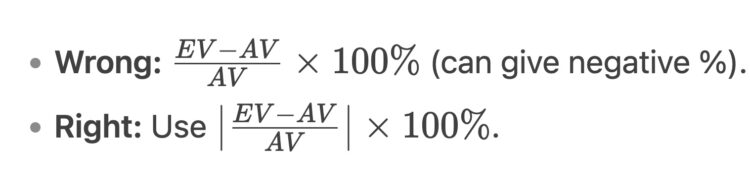
❌ Swapping Accepted and Experimental Values
- Always subtract Experimental – Accepted.
❌ Misinterpreting High vs. Low Error
- <5%: Usually acceptable (varies by field).
- >10%: Likely needs investigation.
How to Reduce Percent Error
- Calibrate Instruments
- Use precise tools (e.g., digital thermometers).
- Repeat Measurements
- Average multiple trials.
- Control External Factors
- Minimize temperature/human errors.
Real-World Example:
NASA reduces percent error in rocket launches by testing engines 100+ times.
Tools for Calculating Percent Error
- Handheld Calculators: Basic arithmetic.
- Excel/Google Sheets:
=ABS((B2-A2)/A2)*100
(Where A2 = Accepted Value, B2 = Experimental Value)
- Online Calculators:
- CalculatorSoup
- Omni Calculator
Embrace the Error!
Even experts make measurement mistakes—what matters is quantifying and improving. Whether you’re a student, scientist, or business analyst, mastering percent error helps you:
✅ Validate your work
✅ Improve accuracy over time
✅ Make data-driven decisions
Now you try: Measure something twice, calculate the % error, and see how close you get!